Tankless vs Tank Water Heater: Which Suits a Lorton Home?
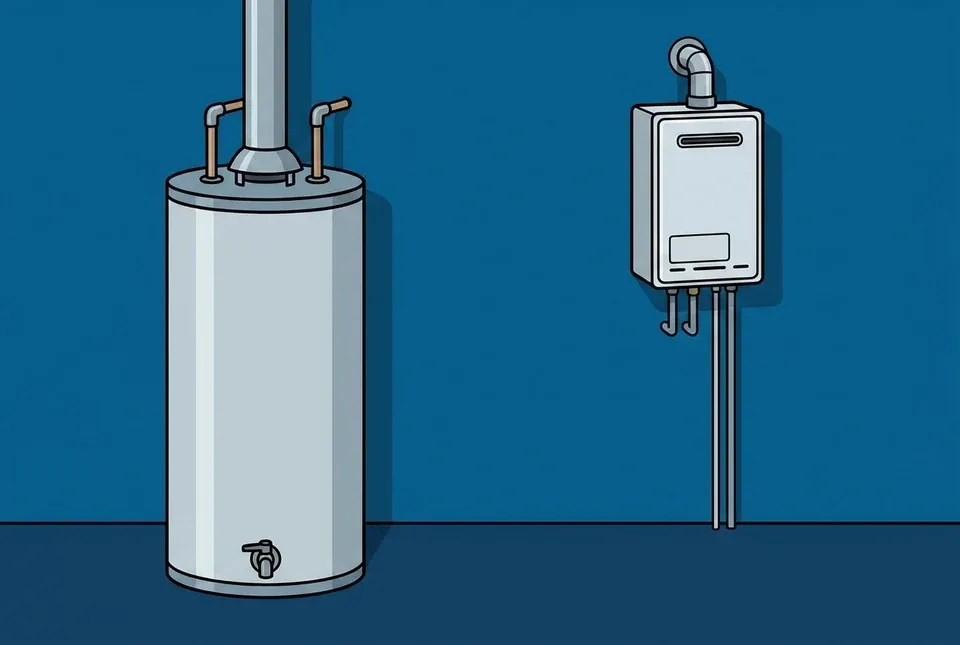
The pitch for tankless is easy to like: hot water that never runs out, from a box the size of a carry-on instead of a cylinder eating a corner of the basement. It is a real advantage and plenty of Lorton homes are better off with one. But the conditions are where people get surprised. What a unit can actually deliver depends on how cold the incoming water is, which changes with the season, and the fuel and venting it needs are often not what is already in the house. If you want the version specific to your house, tankless water heater installation in Lorton starts with a look at what you have. Our family has been doing this across Northern Virginia since 1956.
Does a Tankless Water Heater Save a Lorton Home Money on Bills?
Usually yes, on the operating side, and the reason is simple. A storage tank keeps forty or fifty gallons hot around the clock whether anyone wants it or not, and the heat it loses to the basement is called standby loss. A tankless unit has nothing to keep warm. ENERGY STAR describes the mechanism plainly, noting that by heating water only when it is needed, certified gas tankless units cut water-heating expenses while also delivering continuous hot water.
The complication is that the operating saving is not the whole equation. A tankless unit costs more to buy, and it frequently costs more to install, for reasons covered further down. Consumer Reports, which tested a range of whole-house tankless models against conventional storage tanks, put the caution bluntly: replacing a tank with a tankless can be expensive, and the payback period can be longer than the warranty on the unit.
So tankless is usually the better performer and sometimes the better investment, and which one you are getting depends on your own house. It is not a question anyone can answer from a table.
Is a Tankless Unit Worth It for a Lorton Home That Runs Two Showers?
This is where a tank and a tankless are measured in genuinely different units, and the difference matters more than any other spec.
ENERGY STAR puts it exactly: while the capacity of a storage heater is based on how many gallons fit in the tank, tankless models are rated by how many gallons per minute they can produce, and the more likely you are to have the shower, dishwasher and clothes washer running at once, the larger that rating needs to be. A tank has a reservoir and a recovery time. A tankless has a ceiling, and once you are at it, everything downstream gets cooler.
The same ENERGY STAR guidance gives average demands worth doing arithmetic with: a shower or bathtub draws about 2.5 gallons per minute, a clothes washer about 3.3, a kitchen or bathroom sink about 2.2, and a dishwasher about 1.3. Two showers at once is roughly 5 gallons per minute before anything else in the house is running. Add a dishwasher and you are near 6.3.
That is the whole sizing conversation, and no amount of efficiency makes up for being undersized. Which leads to the next section, because that rated capacity is not a fixed figure.
Why Do Lorton Winters Cut the Output Rate of a Tankless Heater?
Here is the part that national comparison guides leave out, and it is the single most useful thing in this article for a Northern Virginia homeowner.
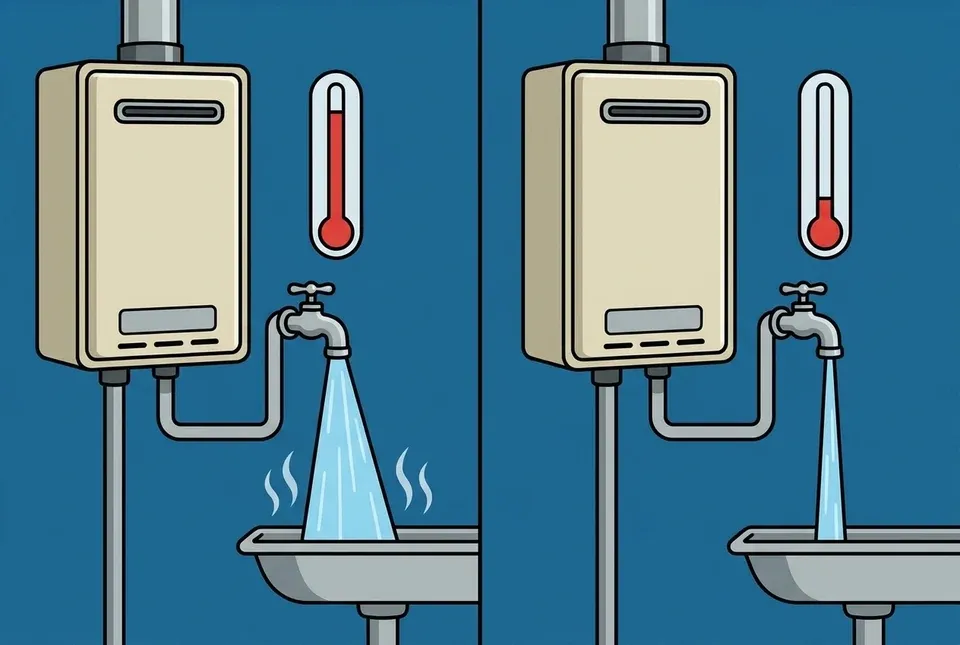
A tankless unit’s gallons-per-minute rating is always quoted at a particular temperature rise, meaning the gap between the water coming in and the temperature you have asked for. The unit has a fixed heating capacity. If the gap it has to close is small, it can heat a lot of water per minute. If the gap is large, it can heat proportionally less. A commenter in a trades forum, in the most-upvoted answer on a thread from a disappointed new owner, laid out the arithmetic: flow through a tankless is based on temperature rise, every unit’s maximum flow is quoted at a very low rise, and rise is simply your incoming cold water temperature subtracted from your setpoint.
Now apply Lorton’s calendar. Incoming water in late summer is comparatively warm, so the required rise is modest and the unit hits something near its headline rating. In January the same water arrives far colder, the required rise is much larger, and the usable output falls accordingly. Nothing has broken. The unit is doing what it was always rated to do, at a condition its marketing number never described.
Homeowners meet this as a seasonal mystery. One put it in a sentence: they cannot have both showers going in winter, because the ground water is too cold to get that flow rate up to temperature. Same house, same unit, same habits, different month.
Two clarifications keep this honest. Not every unit behaves identically: some modulate, actively reducing flow to hold your setpoint, while others deliver their rated flow at whatever rise they can manage, so you feel the shortfall as cooler water rather than less of it. And the setpoint is yours to control. As one forum answer put it, the heater will give you all the 140-degree water it can make, but it can make considerably more 120-degree water. Turning the temperature up on a cold morning does the opposite of what people expect.
The practical consequence is that a tankless for a Lorton home should be sized against a winter rise, not a summer one. Sizing against the number on the box is how households end up disappointed in January.
Do Gas Line and Venting Upgrades Make a Lorton Tankless Install Expensive?
Sometimes, and this is the cost people do not budget for, because it has nothing to do with the unit’s price tag.
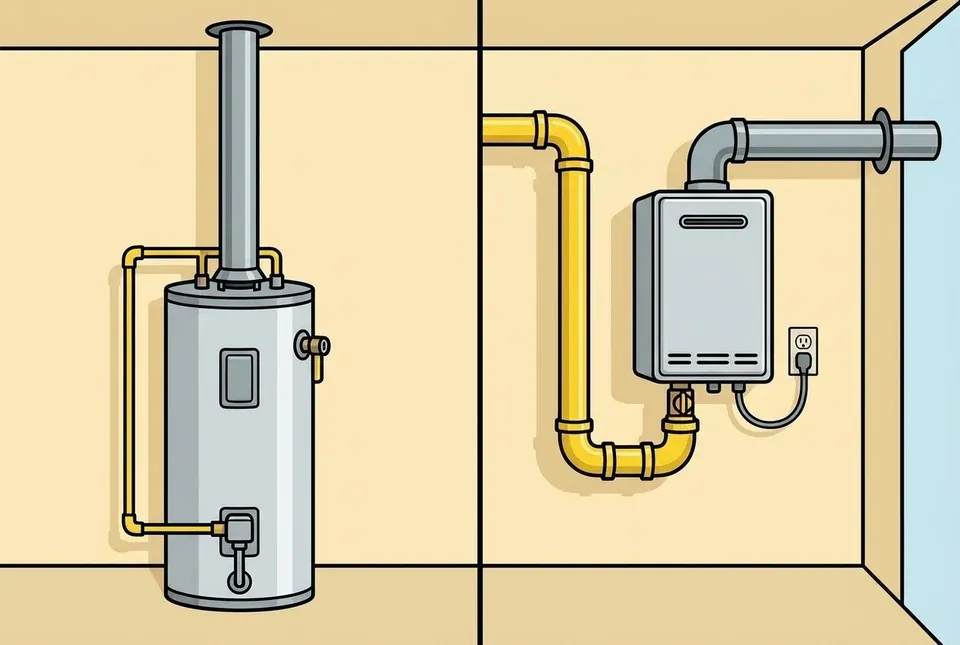
A gas tankless fires at a far higher input than a storage heater, because it heats on demand rather than slowly. That often means the existing gas line is undersized, and it always means the exhaust arrangement is different. ENERGY STAR’s buying guidance tells homeowners to have the installer confirm the sizing, determine whether the existing natural gas line is sufficient, check whether electricity is available near the heater for the fan on power-vented models, and identify how combustion gases will be vented. Those four checks are the retrofit cost, and they are house-specific.
They are also not automatic. In one discussion a homeowner described a straightforward retrofit of an older house, mounting the unit outside so it vented directly and needed only a standard outlet for its ignition. Another homeowner needed new electrical service and heavy circuits. Same decision, opposite bills, because the houses were different.
Which is why we would rather look at your gas supply and vent path than hand you a range. New construction is the easy case; a retrofit is answered on site.
Does Hard Water Make Tankless Upkeep Expensive in a Lorton Home?
It makes it non-optional, which is not quite the same thing.
Northern Virginia water carries meaningful mineral content, and minerals come out of solution where water is heated hardest. In a tankless unit that is the heat exchanger, a narrow path rather than the open floor of a tank, so deposit there costs efficiency and eventually output. The maintenance answer is an annual descaling service, and it is the single largest ongoing difference between owning a tankless and owning a tank. How that service is performed is its own subject and not one this article takes on, because the question here is choosing rather than servicing.
Owners genuinely divide on how much this should weigh. The most-upvoted comment in one long homeowner thread came from someone who said plainly they are not a professional, had run a tankless for twenty years on minimal DIY maintenance, and added the caveat that their water is soft, and if yours is not, that could be the deciding factor against. A well-supported reply disagreed just as directly: they had hard water too, flushed annually after learning how, and found it a few minutes of work.
What the disagreement shows is that hard water does not decide the question by itself. It converts a maintenance task from optional to scheduled. If you will keep that schedule, hardness is a manageable cost of ownership. If you know you will not, a tank is more forgiving of neglect, and that is a legitimate reason to choose one. Knowing your own water is the first step either way, and we test what is actually in it before recommending anything.
Is a Storage Tank Still the Efficient Choice for a Large Lorton Family?
Frequently, yes, and the reason is the same ceiling from earlier read from the other direction.
A large household’s demand is spiky: several showers in one morning, laundry, dishes. A tank answers a spike with a reservoir it has already banked. A tankless answers with capacity, and if simultaneous demand exceeds its output at that day’s temperature rise, everyone gets a lukewarm compromise.
Modern tanks are also better than their reputation. Insulation has improved and a well-sized tank handles a busy morning without drama. One owner of a fifty-gallon tank described running out exactly once, with eight people showering back to back while the dishwasher and washing machine ran.
A tank has its own failure mode, since sediment settling on the floor of one is what turns its hot water lukewarm over the years, and why a tank stops producing hot water covers that. So the household profile matters more than the technology. A big family with concentrated demand is a good tank candidate; a household that wants long showers and its floor space back is a good tankless candidate. Neither is the upgrade. They are different tools.
Should a Lorton Homeowner Budget for a Tank or Tankless Replacement?
Budget for the one that fits the house, and get the number from someone who has looked at the house.
We are not going to publish a price range, and it is worth saying why rather than leaving a gap. The honest cost depends on your gas supply, vent path, electrical situation and where the unit will hang. A range wide enough to be true for every Lorton home is too wide to plan against, and a narrow one would be wrong for most readers. The published comparison tables that make this look simple disagree with each other by thousands of dollars.
What you can budget for is the shape of it: a tankless costs more up front and less to run, a tank the reverse, and the crossover depends on how long you stay and how much hot water you use. How many years each actually lasts is its own question, answered in how long a water heater lasts in a Stafford home. Replacing in an emergency, a tank is almost always the faster path back to hot water, because a like-for-like swap needs no new gas or venting work. Planning ahead is when tankless is worth pricing properly.
The Bottom Line on Tankless vs Tank in Lorton
Tankless wins on endless hot water, floor space and standby loss. Tank wins on upfront cost, simultaneous demand and tolerance of neglect. Both are correct answers to different houses.
Three things are worth carrying away. Size a tankless against a Lorton winter, not the number on the box. Find out what the gas line and venting actually require before you compare prices, because that is where retrofit budgets move. And be honest about annual maintenance, because hard water turns it from a good idea into a commitment.
If you want that assessed rather than estimated, we will look at what is in the house first. Being third-generation and family owned rather than private equity backed is why we would rather talk you out of the wrong one than sell it to you.