Why Your Home AC Smells Musty in Springfield
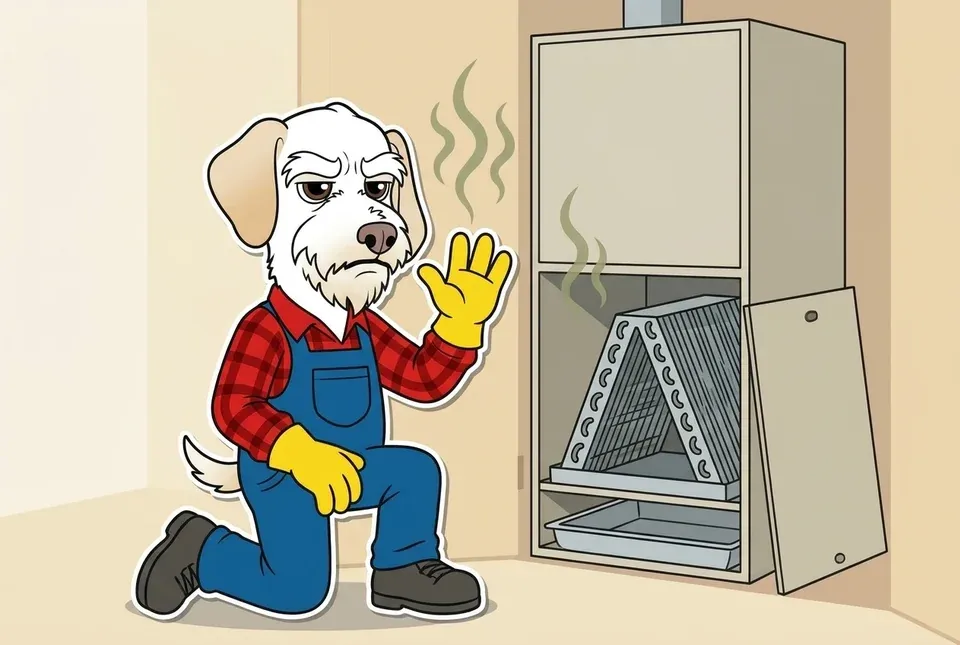
That damp, closed-basement smell rolling out of your vents is almost never coming from the air. It is coming from something wet inside the equipment. Your air conditioner pulls gallons of moisture out of the air on a humid Virginia afternoon, so standing water and a damp coil sit in the cabinet all season, and growth follows. The usual sources are a drain pan that is not draining, bacteria on the evaporator coil, mildew in the duct runs, or a filter left in too long. Our family has looked after homes here since 1956, and a call for AC repair in Springfield that starts with a smell is one we can usually narrow down before opening the cabinet. One exception first: sulfur or rotten eggs is not an air conditioning problem, so skip to the safety section below.
What Does a Musty Smell From the Drain Pan Mean in a Springfield Home?
Start here, because it is the most common source and the easiest to see.
The drain pan sits under the evaporator coil and catches condensation running off it. Working correctly it never holds much, because water arrives and leaves through the condensate line. When that line blocks, the pan stops emptying and a shallow reservoir of stagnant water sits in a warm, dark cabinet for weeks. That grows the algae and bacterial sludge behind a musty odor, and the blower pushes air straight over it into your rooms.
The tell is timing. If the smell is strongest in the first minute after startup and fades as the system runs, you are smelling something in the air path near the blower rather than a problem in the house.
A blocked line usually announces itself a second way, with water where it should not be, and we cover clearing a clogged condensate drain separately. Smell with no water may mean the pan drains just slowly enough to stay damp without overflowing, which still counts as a clog worth clearing.
When Does Dirty Sock Syndrome Make a Springfield AC Smell Musty?
Classically on the first properly humid days of the season, or right after you switch from heat over to cool.
The name is not something we invented. It is what the trade calls a film of bacteria and organic material built up on the fins of the evaporator coil. One commenter in an r/hvacadvice thread described it plainly, attributing the odor to bacteria on the evaporator coil and noting it tends to appear in cooling and not in heating. That detail is the useful part: a coil in heating mode gets warm enough to bake off some of what grows on it, while in cooling it stays cold and wet for months, which is exactly what that film wants.
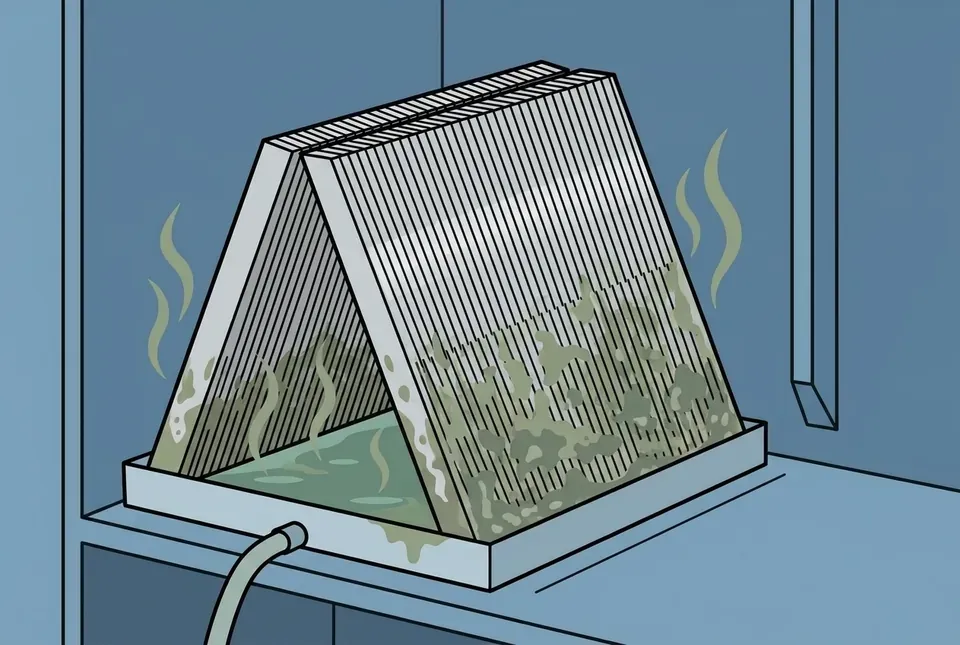
Two honest caveats. A clean-looking coil does not rule it out: in that same thread the homeowner reported back that a technician opened the unit, the coil looked essentially new, it was treated with a foam cleaner anyway, and the smell did not change at all. Biofilm lives between fins where nobody is looking. Heat pumps are a special case too, and another commenter described the mechanism well, that the coil never gets hot enough to burn off microorganisms growing on it from summer condensate.
A germicidal UV lamp at the coil is one tool used against this, and we weigh the options in our guide to UV lights in an HVAC system, with one caution: ozone generators are a different product, and one homeowner reported having theirs pulled back out because the ozone smell was worse than what it replaced.
What If a Springfield AC Smells Like Burning or Rotten Eggs, Not Mildew?
These are different problems and neither is a maintenance item. Read this before you do anything else.
Rotten eggs or sulfur means a possible gas leak. Natural gas has no smell of its own, so utilities add a sulfur compound specifically so you will notice a leak. If you smell it, leave the house immediately, take everyone with you, and call your gas utility or 911 from outside. Do not try to find the source. Do not flip light switches, do not unplug anything, and do not use your phone until you are outdoors and away from the building. Anything that can make a spark is what you are avoiding, and this is not a call to wait on. Plenty of homes here run a gas furnace sharing an air handler with the AC, so a gas smell arriving through the vents in July is entirely possible.
A burning or hot electrical smell is a separate concern. A sharp acrid odor, or hot plastic and scorched wiring, points at an electrical fault such as a seizing blower motor, a failing capacitor or damaged wiring. Shut the system off at the breaker rather than only at the thermostat, and have a technician look before you run it again.
Are Mildew Smells Coming From the Ducts in Your Springfield Home?
Sometimes, and this is the part of the problem most oversold to homeowners.
Ducts pick up mildew when they get damp, which happens where uninsulated metal runs through a humid unconditioned space and condensation forms on it. Attics and crawl spaces are the usual locations, and a duct leak drawing in humid attic air will do it too. The smell then tends to be even throughout the house rather than concentrated at the equipment.
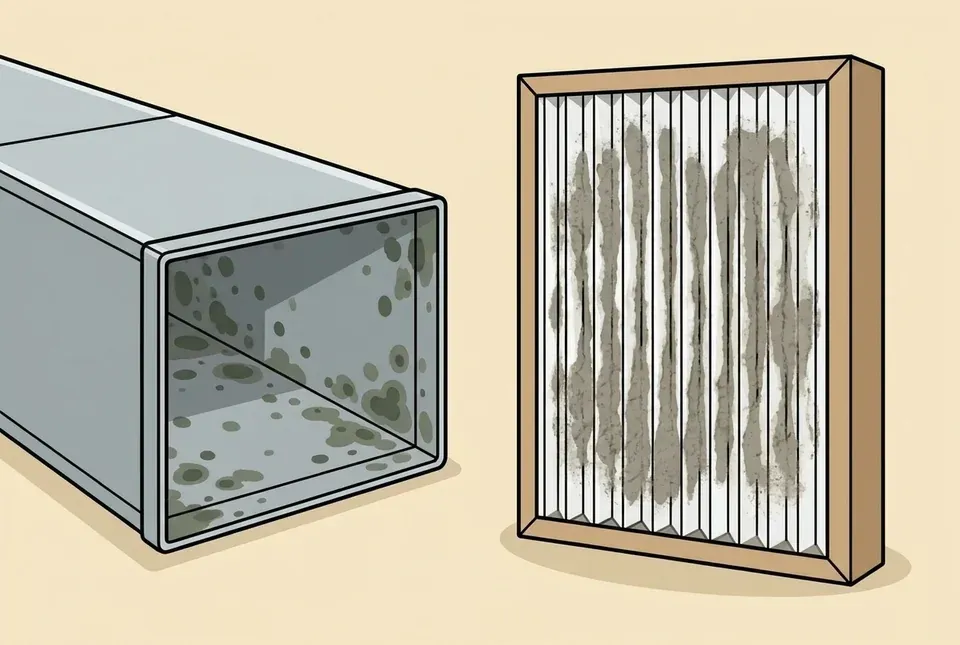
Duct cleaning is sold hard in this market, and the EPA’s position is more measured than the advertising. Its guidance on whether to have your air ducts cleaned states that duct cleaning has never been shown to actually prevent health problems, that cleaning is probably unnecessary if you see no indication of contamination, meaning no musty odor and no visible mold growth, and that a provider who fails to follow proper procedures can cause indoor air problems rather than solve them.
That cuts both ways. The same guidance does list substantial visible mold growth inside hard-surface ducts as a reason to consider cleaning, and the case it makes for skipping the job rests on there being no musty odor and no visible growth. Read plainly, that means a smell takes you out of the do-nothing case without putting you straight into the cleaning case. It is a reason to have someone open an access panel and show you what is actually in there, rather than to buy a whole-house cleaning off a coupon.
Can a Dirty Filter Make a Springfield AC Smell Musty?
Yes, and it is the first thing to check because it costs almost nothing to rule out.
A filter collects material out of the airstream, so a loaded one holds months of dust, dander and pollen. Add humidity and it becomes its own source of odor, sitting in the path of every cubic foot of air entering your house. Pull it out and look at it in daylight. Grey and matted means it has been in too long, and if it smells when you hold it you have found part of your answer.
The larger effect is indirect. A clogged filter restricts airflow across the evaporator coil, so the coil runs colder and stays wetter than designed, which is precisely the condition the biofilm above thrives in. Change it on a schedule rather than when you remember, which in a house with pets means checking monthly.
Does an Oversized Springfield AC Leave Enough Moisture to Smell Musty?
It can, and this one surprises people because the symptom is a system that appears to be working well.
Removing humidity takes runtime. Moisture condenses on the coil gradually while the system runs, and a long steady cycle pulls a great deal of water out of your indoor air. A unit with more capacity than the house needs cools to the thermostat setting quickly and shuts off, satisfying the temperature long before it has done much about the moisture. The result is a house that is cold and still faintly clammy.
That matters because damp is the precondition for everything else here. Elevated humidity feeds mildew in the ducts and keeps the coil environment wetter. Capacity is set at installation rather than adjusted afterward, so this is a sizing question, not a repair. If humidity itself is what you want to attack, we compare the approaches in our article on whole-house dehumidifiers versus portable units. What we would not do is let anyone sell you a dehumidifier before somebody has confirmed that high humidity, and not a dirty coil, is what you actually have.
How Do You Spot Mold in a Springfield AC Before It Affects Your Health?
You look in four places and resist both of the easy answers about what it means.
Check the drain pan for standing water and dark slime, the evaporator coil for visible fuzz between the fins, the return grille and the first foot of duct behind it, and the filter housing for dampness or spotting. Growth is not always visible where the smell is strongest, so persistent odor with nothing obvious to see is a reason to have the cabinet opened rather than to conclude it is nothing.
On the health question we would rather give you the source’s own wording than a reassuring line or a frightening one. The EPA’s guide to mold, moisture and your home says molds have the potential to cause health problems, describing them as allergens and irritants that can produce reactions such as sneezing, runny nose, red eyes and skin rash, and notes reactions are more likely in people who are allergic or sensitive. That is a real concern, and it is deliberately not a claim that mold exposure makes everyone ill.
One piece of that guidance is worth acting on immediately. The EPA advises against running an HVAC system you know or suspect is contaminated with mold, because doing so could spread it through the building, and recommends drying water-damaged material within 24 to 48 hours. A leak and a smell appearing together should be treated as urgent.
When Does a Musty Smell in a Springfield Home Need Coil Cleaning?
When the pan is clear, the filter is new, the humidity is reasonable, and the smell is still there.
That sequence matters, because a professional coil cleaning is the most invasive item here and is frequently sold before the cheap checks have been done. Done properly it means access to both faces of the coil, a cleaner appropriate to the equipment, and clearing the drain path and pan at the same time so the material just loosened does not go straight into a sluggish line. Rinsing the visible face with a spray can is not the same job.
Set expectations honestly, though. The homeowner in that thread had the coil professionally treated and reported no change at all. Biofilm established deep in a coil can survive a single cleaning, and a persistent case may need the odor addressed at the source of the moisture rather than at the surface of the metal.
Prevention is the better economics. ENERGY STAR’s maintenance checklist includes inspecting the condensate drain, noting that a plugged drain can cause water damage in the house and affect indoor humidity levels. Clearing that line and checking the pan and coil is part of every seasonal AC maintenance visit we run. Where a house has a recurring problem rather than a one-off, our indoor air quality work looks at the whole moisture picture instead of treating the same coil every July.
If your vents smell like a damp basement and you would rather someone opened the cabinet and showed you what is in there, we can do that. Same-day service, a real person on the phone, and a technician who will tell you if the cheap fix is the right one. That approach is why families here have stayed with us for three generations.