The Danger of Portable Dehumidifiers and Advantages of Whole-House Dehumidifiers
Anyone who has spent a July in Northern Virginia knows the feeling: the AC is running, the thermostat says 74, and the house still feels sticky. That clamminess is humidity, and it does more than make you uncomfortable. It feeds mold, warps wood, sets off allergies, and makes your air conditioner work harder than it should.
The usual first move is a portable dehumidifier from the hardware store. We understand the appeal, and we also see how that story ends in basements all over the area. Here is the honest comparison between portable dehumidifiers and whole-house dehumidifiers.
Quick answer
Portable dehumidifiers are a short-term patch with real drawbacks: they have been the subject of major fire-hazard recalls covering millions of units, they need their bucket emptied constantly, they are loud, they only treat one room, and they use a surprising amount of electricity. Whole-house dehumidifiers install into your HVAC system, drain themselves, run quietly, and hold your entire home at a set humidity level. If you only need to dry out a closet for a week, a portable unit is fine. If your home is muggy every summer, whole-house is the better answer.
Here is the full picture.
The safety problem with portable dehumidifiers
This is the part that surprises people. Portable dehumidifiers have been the subject of major fire-hazard recalls in the United States covering millions of units across well-known brands. The failure pattern is usually the same: an electrical component or wiring inside the unit degrades, shorts, and overheats, sometimes badly enough to start a fire.
Part of the risk comes from how these units get used. A portable dehumidifier in a damp basement often runs around the clock, unattended, for months at a time, plugged into whatever outlet was closest. That is a hard life for a compact appliance, and exactly the kind of duty cycle that finds weak components.
If you own a portable unit, check the model number against the recall database at the Consumer Product Safety Commission’s website, and never run one on an extension cord or a crowded power strip.
The bucket, the noise, and the electric bill
Even when a portable dehumidifier works exactly as designed, living with one is a chore.
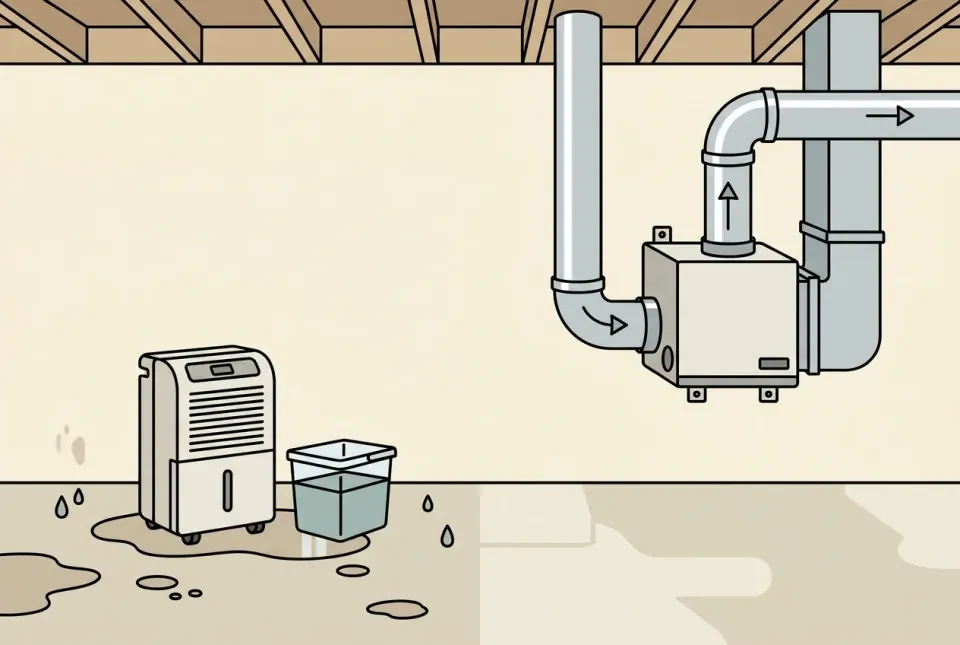
The bucket. In a humid Virginia summer, a portable unit can fill its reservoir in a day or less, and when the bucket is full, the machine stops. Miss a day of emptying and your basement spends that day getting damp again.
The noise. A portable dehumidifier is a compressor and a fan sitting in your living space, roughly as loud as a window air conditioner. Fine in an unfinished basement, miserable in a finished rec room or bedroom.
The energy use. Portable units are not efficient. A small unit grinding away around the clock adds a noticeable line to your summer electric bill, and because it only conditions one room, your air conditioner keeps fighting moisture everywhere else at the same time. You end up paying twice.
The coverage. This is the quiet dealbreaker. A portable dehumidifier treats the room it sits in, period. Dry the basement and the first floor still feels sticky. Some homeowners end up with two or three units scattered around the house, each with its own bucket, noise, and plug.
What whole-house dehumidifiers do differently
A whole-house dehumidifier installs directly into your HVAC ductwork, usually near the air handler. As air circulates through the system, the dehumidifier pulls moisture out of it before it is distributed through the house. Every room that gets conditioned air gets dried air.
The practical differences from a portable unit:
No bucket, ever. A whole-house dehumidifier drains automatically through a condensate line, the same way your air conditioner already does. Set your target humidity on the control (we usually recommend 45 – 50 percent in summer) and the system holds it. There is nothing to empty and nothing to remember.
Whole-home coverage. Because it works through the ductwork, one unit treats the entire house, including the rooms you rarely think about until you smell the mustiness.
Quiet. The equipment lives with your furnace or air handler, not in your bedroom. Most homeowners never hear it run.
Lower operating cost per pint. Whole-house units remove far more moisture per kilowatt than portables, and drier air lets your air conditioner do its actual job of cooling instead of wringing water out of the air.
Safety. A whole-house dehumidifier is professionally installed, properly circuited, and sized for continuous duty. It is built for exactly the workload that wears out portable units.
Why this matters so much in Northern Virginia
Our summers are genuinely muggy, with outdoor dew points that sit in the sticky range for weeks. Add the housing stock around here, with below-grade basements and vented crawl spaces, and you have a region practically designed to grow mold.
Basements and crawl spaces are where we see the worst of it: condensation on cold water pipes, damp-smelling carpet, efflorescence on block walls, and mold spotting on stored boxes. A single portable unit in a big basement usually cannot keep up, and it does nothing for the crawl space under your feet. A properly sized whole-house dehumidifier, sometimes paired with a dedicated sealed-crawl-space unit, actually solves the problem instead of chasing it.
So which one should you buy?
If you have a one-time moisture problem, say a carpet that got wet or one small room that needs drying for a couple of weeks, a portable dehumidifier is a reasonable tool. Check it against the recall list and do not run it unattended for months.
If your whole home feels sticky every summer, if your basement smells musty, or if you are emptying a bucket every day from May through September, you have outgrown portables. A whole-house dehumidifier costs more up front, but it removes the fire worry, the noise, the daily chore, and the humidity, all at once, in every room.
Frequently asked questions
How do I know if my portable dehumidifier was recalled? Search the Consumer Product Safety Commission’s recall database at cpsc.gov for your brand and model number. If your unit is listed, stop using it immediately and contact the manufacturer for the remedy.
What humidity level should my home be in summer? Aim for 45 – 50 percent relative humidity. Below about 60 percent, mold and dust mites struggle; above it, they thrive. A whole-house dehumidifier holds that target automatically.
Can a whole-house dehumidifier work with my existing HVAC system? Almost always, yes. The unit ties into your existing ductwork and drain line. Installation is typically a single-day job, and we size the unit to your home’s square footage and moisture load.
Will a whole-house dehumidifier help my air conditioner? Yes. Drier air feels cooler, so most homes can run the thermostat a bit higher without losing comfort, and the AC no longer has to pull double duty removing moisture. That means shorter run times and less wear.
Fighting a sticky house or a musty basement? Leonard Splaine installs whole-house dehumidifiers across Northern Virginia, sized to the home and set up to drain and run on their own. Call 703-494-2855 or explore indoor air quality services.