Why Is Your AC Leaking Water in Woodbridge?
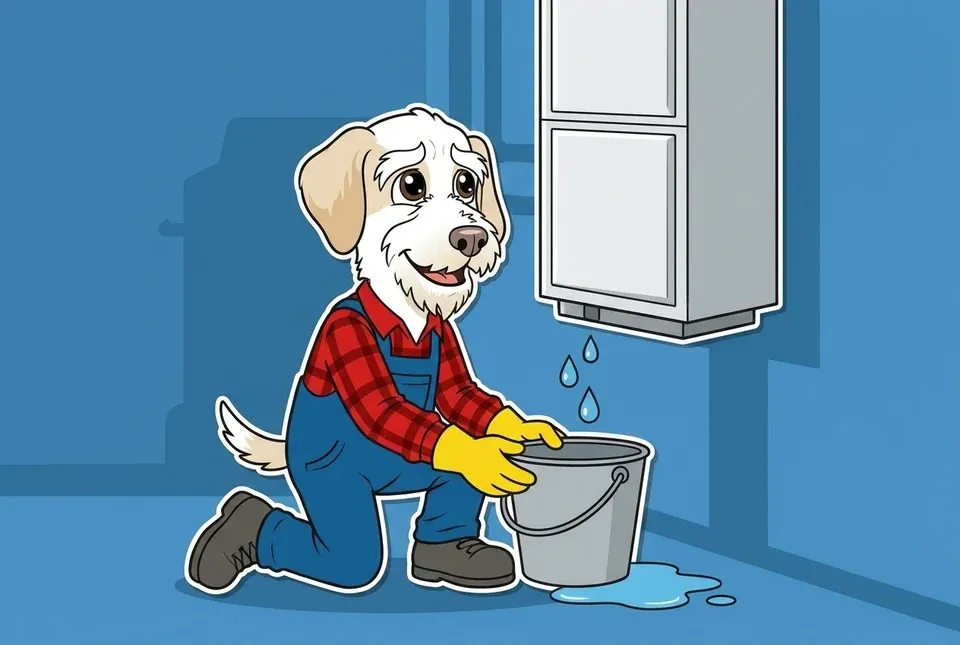
An air conditioner is a dehumidifier that happens to cool. On a humid Virginia afternoon it can pull several gallons of water out of the air inside your house, and every drop has to go somewhere. So when you find a puddle under the air handler or a brown ring spreading across a ceiling, the trouble is almost never the cooling side. It is the drainage side. The usual suspects are a clogged condensate drain line, a rusted drain pan, a failed condensate pump, or a frozen evaporator coil melting faster than the drain can keep up. Our family has looked after Northern Virginia homes since 1956, and AC repair in Woodbridge that starts with water on the floor is one of the most common calls we run all summer.
How Do You Tell If a Woodbridge Home’s AC Leak Is Water or Refrigerant?
If you are looking at a puddle, it is almost certainly condensate. Plain water: clear, no smell, collecting under or near the indoor unit. That is a drainage problem.
Refrigerant behaves nothing like that. It is under pressure and boils away well below room temperature, so it escapes as a gas rather than pooling on your floor. What you see instead is an oily film on the copper lines, sometimes a faint hiss, often ice on the line set, and cooling that has quietly gotten worse over weeks. If your air is barely cold and there is frost on the pipe going into the wall, that is a different problem, and we cover the signs an evaporator coil is leaking refrigerant separately.
Leave the refrigerant side alone. Do not loosen a fitting, remove a service cap, or press anything on those lines to test them. Escaping refrigerant can cause frostbite, and venting it violates federal clean air rules. That work belongs to a certified technician.
What Should You Check When a Woodbridge AC Still Cools but Leaks Water?
This is the case that catches people out, and it is why a small drip so often becomes a drywall repair.
If the house is still getting cold, the refrigeration side is doing its job. Moisture is condensing on the coil exactly as designed, and only the plumbing that carries it away has failed. Nothing about the comfort in your living room signals a problem, so the leak looks minor enough to wait for the weekend. Meanwhile, in a Woodbridge home with the air handler in the attic, the water is finding the ceiling below it.
Look outside for one specific thing. Most systems have a primary drain and a secondary, sometimes called the emergency drain, which usually terminates somewhere conspicuous like above a window. If a pipe outside is dripping that never dripped before, that is often the emergency line doing its job, which means the primary is already blocked. As the top reply in one r/HVAC thread on this symptom put it, once the emergency drain clogs too there is nowhere left for the water to go except the attic, the subfloor, or the sheetrock.
Cooling normally is not reassurance. It is the absence of a second symptom. If your system has also stopped cooling properly, we walk through seven reasons an AC runs without cooling.
How Do You Clear a Clogged Drain Line Leaking Into a Woodbridge Home?
A clogged condensate line is the most common cause of an indoor water leak, and it is the one repair here a careful homeowner can often handle. The clog is rarely debris. It is biological sludge, algae and dust bound together in a line that stays wet and dark all season.
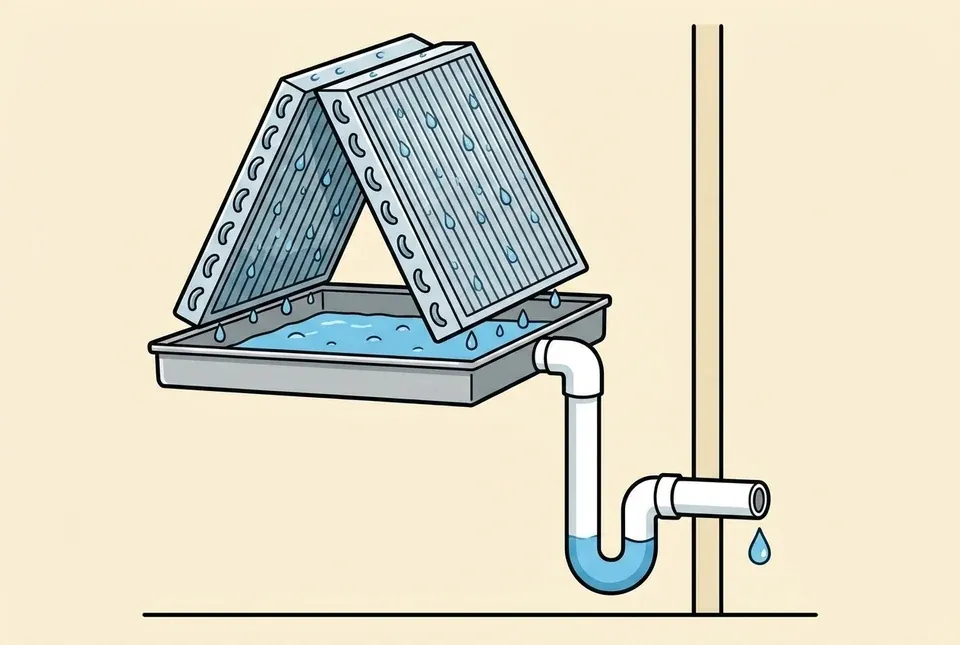
Work in this order:
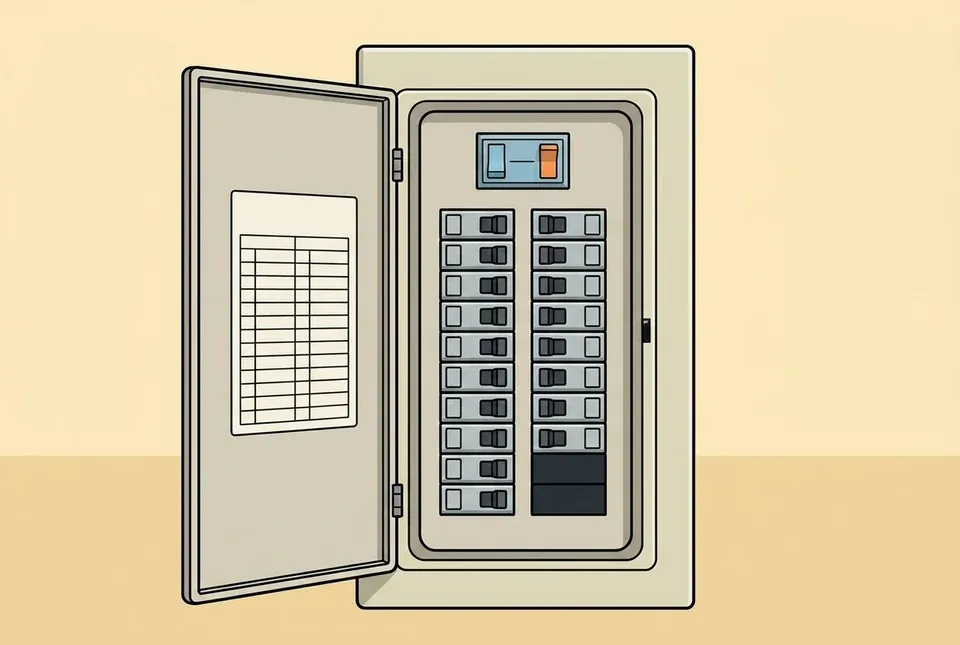
- Kill the power first. Thermostat off, then the breaker for the air handler.
- Find the outdoor end. A PVC pipe, usually near the condenser or the foundation. Running normally it should drip steadily. A trickle or nothing points to a clog upstream.
- Pull, do not push. Fit a wet/dry shop vacuum over the outdoor end, close the gap with a rag so it seals, and run it a full minute. Compressed air can pack a clog deeper into the trap instead of removing it.
- Watch what comes out. When you break the seal several gallons may follow, and the water in the vacuum will be filthy. That is your confirmation.
- Test it. With the power off, pour clean water into the drain pan and confirm it exits outside. Restore power, then check for that steady drip.
Two cautions. A shop vacuum clears the blockage but leaves the buildup that caused it, so treat it as a fix for today rather than for the season. The clog usually re-forms at the trap, the U shaped bend that holds standing water by design. And on chemicals: opinion online is split between a diluted bleach flush and plain white vinegar. Pick one and never combine them. Bleach mixed with vinegar, or with any ammonia-based cleaner, can release a toxic gas.
If the line clogs again within weeks, that is worth a service call rather than a third afternoon with a shop vac. Recurrence can point to a drain line that was never sloped correctly at installation, and no amount of flushing fixes that.
How Do You Check a Frozen Evaporator Coil Leaking in a Woodbridge Attic?
Sometimes the water is not a drainage failure at all. It is ice, melting.
When airflow across the evaporator coil drops far enough, usually from an air filter nobody has changed, the coil falls below freezing and condensation turns to frost instead of running off. The ice keeps building while the system runs, then thaws all at once, releasing far more water than the pan and drain were sized to handle. That is how a frozen coil in an attic air handler soaks a ceiling even when the drain line is perfectly clear.
Telling this apart from a clog takes two minutes. Check the coil or line set for visible frost, feel the airflow at a supply register, and check the air filter, which is the cause often enough to look at first.
If you find ice, do not chip at it and do not run the system to melt it faster. The fix is a specific sequence, laid out in our guide to thawing a frozen AC unit safely. Put towels and a container under the unit first.
Can You Fix a Rusted Drain Pan Dripping Onto a Woodbridge Ceiling?
Mostly no, and we would rather say so than sell you a patch that fails in August.
The primary drain pan sits directly under the evaporator coil, inside the air handler, and that location is the whole problem. Reaching it means pulling the coil and recovering the refrigerant charge first, which is licensed work. Sealants and pan tablets sold for this buy weeks at best. On an older system, a rusted-through pan is often where the repair-versus-replace conversation starts.
The secondary pan is different. That is the larger sheet metal tray under the whole air handler in an attic, and it catches what the primary pan fails to. Standing water in it means the primary system has already failed and the backup is holding.
If a ceiling below is stained, treat drying as urgent and separate from the AC repair. The EPA’s guidance is to dry water-damaged materials within 24 to 48 hours to prevent mold growth.
How Do You Spot a Failed Condensate Pump in a Woodbridge Basement?
Not every system drains downhill. When the air handler sits in a basement or a closet below the nearest drain, the condensate has to be lifted, and that job belongs to a condensate pump: a small plastic reservoir with a float and a motor.
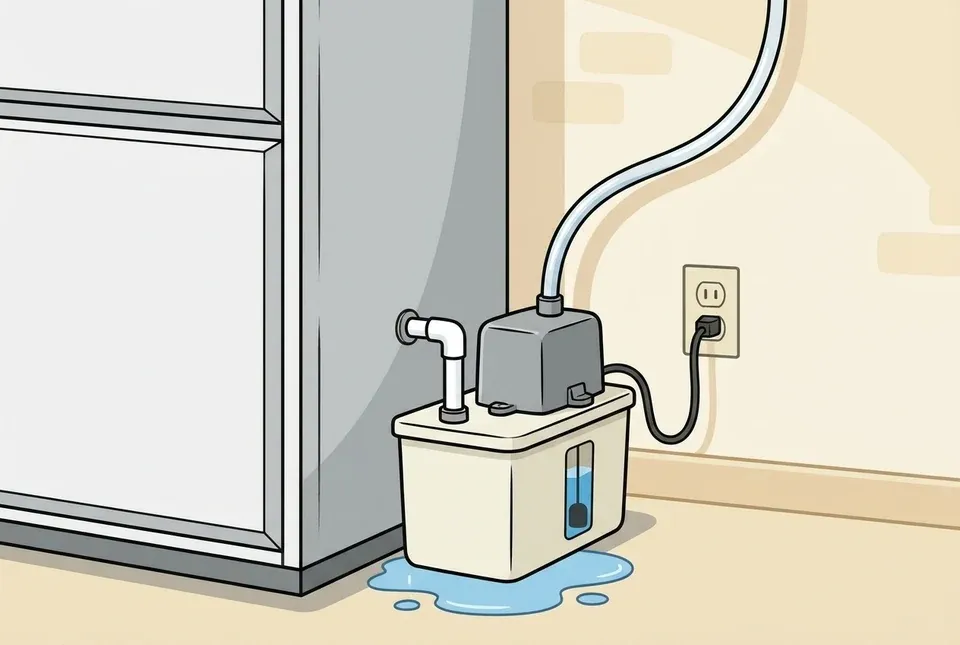
When one fails, the water shows up around the pump rather than at the drain outlet, and the reservoir will be full to the brim. Before assuming it is dead, check whether it has power at all. These pumps often plug into an ordinary outlet, and that outlet can be controlled by a wall switch somebody flipped or sit on a breaker that tripped for an unrelated reason. A pump that is merely unplugged looks exactly like one that burned out.
If it has power and the tank is full, a motor humming without moving water has usually failed. Many pumps also include a safety float switch that shuts the system down before the tank overflows, worth asking about if yours does not have one. Pumps are inexpensive to replace, so this is rarely the costly outcome.
Should You Stop Running a Woodbridge AC That Is Leaking Water?
In most cases yes, and here is the reasoning rather than a blanket rule.
Shut the system off at the thermostat if water is reaching anything that absorbs it: drywall, ceilings, insulation, subfloor, carpet. A warm evening costs less than a ceiling repair. Turning it off fixes nothing, but it stops the water, which is what is doing the damage. Use the fan setting if you want air moving, since the fan alone produces no condensate.
There is one strong reason to stop that has nothing to do with water damage. If a saturated pan or duct has been wet long enough to grow mold, the EPA advises against running an HVAC system you suspect is contaminated, because the system could spread it through the house. A persistent musty smell alongside the leak is your signal that this has moved past a plumbing problem.
The judgment call is real, though. If it is 95 degrees, someone in the house is unwell, and the drip is landing in a secondary pan rather than on the ceiling, running it until a technician arrives may be the right trade.
How Does Seasonal Cleaning Prevent AC Water Leaks in a Woodbridge Home?
Nearly every leak in this article traces back to something a maintenance visit would have caught while it was still free to fix.
The condensate drain is the clearest example. A line flushed each spring does not accumulate the sludge that blocks it in July. ENERGY STAR lists inspecting the condensate drain as a standard part of a maintenance check-up, noting that a plugged drain can cause water damage and affect indoor humidity. The EPA makes the same point from the mold side, recommending homeowners keep drip pans clean and drain lines flowing freely.
The air filter matters as much. Filters get framed as an air quality item, but a clogged one restricts airflow across the coil, and restricted airflow is what freezes coils. Changing it on schedule is the cheapest leak prevention you have.
Clearing the condensate line is part of every maintenance visit we run, along with checking the pan, the pump and the coil. If you would rather not think about any of this until next spring, that is what our seasonal AC maintenance is for. We would rather find a rusting pan in April, when you have options, than in a July heat wave when you do not.
If you have water where it should not be and would rather someone looked at it today, we can do that. Same-day service, a real person on the phone, and a technician who will show you what they found. That approach is why families here have stayed with us for three generations.