Is Your Evaporator Coil Leaking? Signs, Causes, and What to Do
Quick answer
Your evaporator coil is the indoor part of your AC that pulls heat out of your home’s air. When it springs a refrigerant leak, cooling gets weak, run times stretch out, and the system slowly loses its ability to keep up. Here’s the hard part: coil leaks generally can’t be reliably patched, so the real fix is replacing the coil (or, depending on the system’s age, the whole unit). Below is how to spot the problem early and how to think about what it’ll cost.
What the evaporator coil does
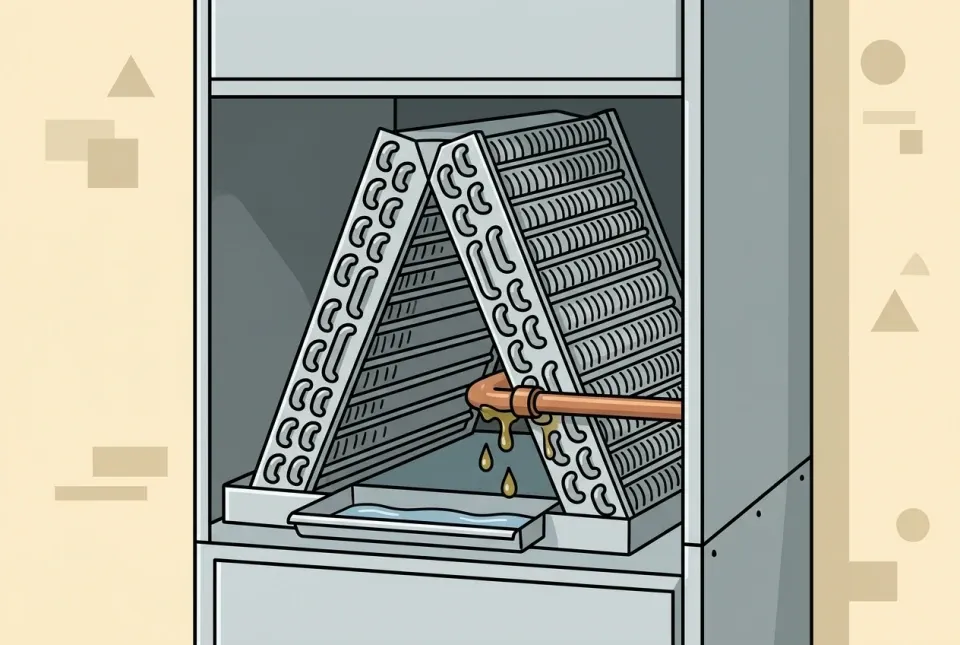
Sitting inside your air handler or furnace cabinet, the evaporator coil is where the magic happens: refrigerant flowing through it absorbs heat and humidity from your indoor air, then carries that heat outside to the condenser. It’s the reason cool, dry air comes out of your vents on a humid Northern Virginia afternoon.
When the coil develops a leak, refrigerant escapes. And because your AC doesn’t consume refrigerant, if the charge is low, it leaked. The coil is the most common place indoors for that leak to happen.
Signs your evaporator coil is leaking
- Weak or lukewarm airflow. The most common first symptom. The bigger the leak, the less the system can cool. Air that’s “cool-ish but never cold” is a classic sign.
- Longer and longer run times. As the charge drops, the AC runs longer to reach the setpoint, then eventually stops reaching it at all. Your electric bill often creeps up alongside.
- A faint sweet smell. Escaping refrigerant can give off a slightly sweet odor, sometimes stronger when the system kicks on.
- The compressor won’t start. The system depends on a certain refrigerant pressure to operate. A significant leak drops that pressure, and safety controls can keep the compressor from starting at all.
- Ice on the coil or refrigerant lines. Low refrigerant can cause the coil to freeze over. Check it yourself: if you see ice, shut the system off and let it thaw fully before running it again, running an iced-up AC can kill the compressor.
One safety note: older systems running R-22 refrigerant can pose a health risk if it’s leaking indoors. Newer refrigerants are less toxic but still shouldn’t be breathed. If you smell something off and cooling has gone weak, get it looked at rather than powering through.
What causes evaporator coils to leak
Most coil leaks aren’t from a single dramatic failure, they’re slow corrosion eating through the thin copper.
- Formicary corrosion. The main culprit. Certain household chemicals, called VOCs (volatile organic compounds), off-gas from cleaning products, air fresheners, new paint, new flooring, and more. In the humid air around the coil, they react with the copper to form microscopic pinhole leaks. It’s death by a thousand tiny holes rather than one big puncture.
- Mold and biofilm. Growth on a damp coil slowly erodes the metal over time.
- Vibration and wear. Years of the system cycling on and off can fatigue joints and tubing.
Northern Virginia’s long, humid cooling season gives corrosion plenty of time to work, which is part of why coil leaks are a common late-summer call for us.
How to fix a leaking coil (and why patching rarely works)
Here’s the honest part: there’s usually no reliable way to patch a leaking evaporator coil. The coil is a large component tucked into a dark cabinet, full of tiny bends and crevices, and a formicary leak is often several microscopic holes rather than one you can find and seal. Chasing them is a needle-in-a-haystack job.
Be wary of any technician whose fix is to “just add more refrigerant” or seal-and-hope. Topping off a leaking system is money poured out, the refrigerant leaks right back out, and you’re paying for it again in a few weeks. Worse, it delays the real repair while the problem gets bigger.
The genuine options are:
- Replace the coil. The direct fix. Makes sense on a newer system that’s otherwise healthy.
- Replace the coil and air handler, or the whole system, if the unit is older or on R-22. When a coil fails on a 12-to-15-year-old AC, replacement is often the smarter money, especially since matching a new coil to an aging condenser and obsolete refrigerant gets complicated fast.
A good technician will lay out the repair-versus-replace math honestly based on your system’s age, refrigerant type, and how much life is realistically left in the rest of it.
How to prevent coil leaks
You can’t stop corrosion entirely, but you can slow it down:
- Cut down on VOCs by choosing low-VOC cleaners, paints, and finishes, and ventilating when you use them.
- Improve ventilation. Bringing in fresh air (an energy or heat recovery ventilator does this without wasting your cooling) dilutes the chemicals that attack the coil.
- Add a UV light at the air handler to suppress the mold and biofilm that erode the metal.
- Keep up with maintenance. An annual tune-up catches a weak, weeping coil and low refrigerant before the system quits on the hottest day of the year.
Frequently asked questions
Can I just recharge my AC and keep going? Not as a real fix. If the charge is low, there’s a leak, and adding refrigerant to a leaking coil just delays the inevitable while wasting money. It also can’t be done responsibly on a coil that’s actively leaking.
How much does an evaporator coil replacement cost? It varies widely with system size, access, and refrigerant type, and it’s not cheap, but on a newer, healthy system it’s usually worth it. On an older R-22 unit, full replacement often makes more financial sense. We’ll give you both numbers so you can decide.
Is a refrigerant leak dangerous? Refrigerant shouldn’t be breathed, and older R-22 is the bigger concern. It’s not usually an emergency, but it’s a reason to schedule service rather than keep running the system.
Think your coil is leaking? Leonard Splaine has diagnosed and fixed AC problems across Northern Virginia for three generations, with upfront pricing and honest repair-or-replace advice, no top-off-and-hope. Call 703-494-2855 or request AC service.