How to Unfreeze Your AC Fast (and How Long a Frozen Coil Really Takes)
Quick answer
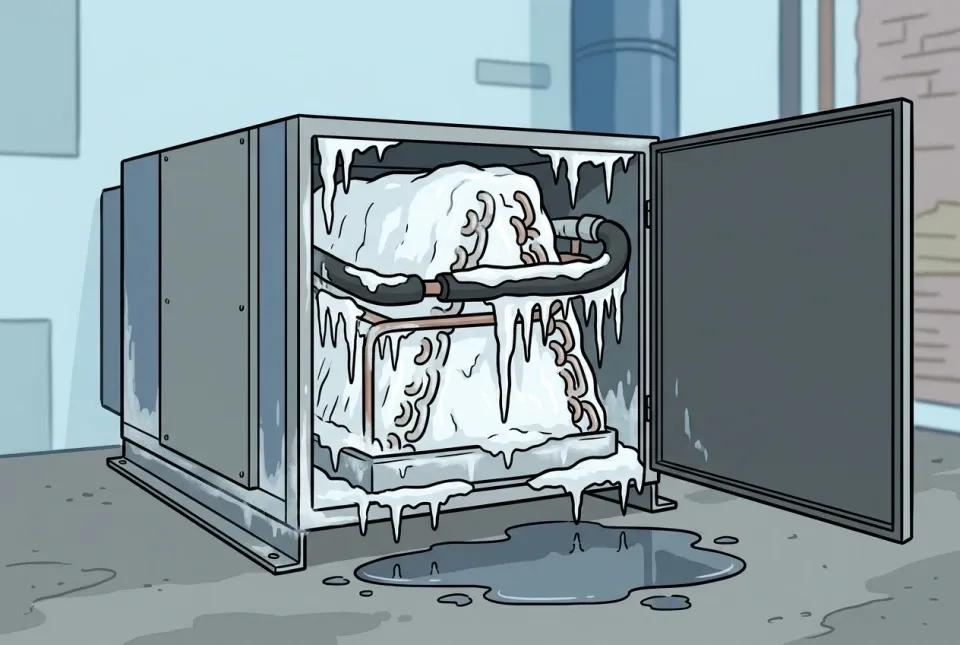
If you see ice on your AC’s indoor coil or the copper lines, do this now: set the thermostat from COOL to OFF, set the fan to ON, and check your air filter. Then let it thaw. A frozen AC takes anywhere from 1 hour to 24 hours to fully unfreeze depending on how much ice built up. The single most important part: stop running it in cooling mode. Keep going and you can send cold liquid refrigerant to the compressor and destroy it, a repair that runs $2,000–$3,500 or forces a full replacement.
Here’s how to thaw it safely, step by step.
Step 1: Switch the thermostat from COOL to OFF
Ice means the refrigerant in your coil is far colder than it should be. That refrigerant is supposed to reach the outdoor compressor as a warm gas. When the coil freezes, cold liquid refrigerant can slug back to the compressor instead, and compressors are built to pump gas, not liquid. That’s what kills them.
Turning the thermostat to OFF stops the system from pumping more cold refrigerant while it thaws. This is the step that protects the expensive part.
Step 2: Set the fan to ON
Move the fan switch from AUTO to ON. This runs the indoor blower continuously, pushing warm household air across the frozen coil and melting the ice much faster.
Don’t leave it on AUTO. On AUTO the blower only runs during a cooling cycle, and you just turned cooling off. The fan would sit idle and the ice would take all day.
How long does it take to unfreeze?
- A light frost: often 1–3 hours.
- A fully iced-over coil: up to 24 hours.
Resist the urge to speed it up with a hair dryer, heat gun, or by chipping at the ice with a screwdriver. You can bend fins, puncture the coil, or crack a refrigerant line. Warm air and patience are the safe tools.
Step 3: Check (and change) your air filter
While it thaws, pull your air filter. A clogged filter is the most common cause of a frozen coil. It starves the coil of the warm airflow it needs, the refrigerant keeps getting colder, and moisture in the air freezes onto it. If you can’t see light through the filter, replace it.
Check the filter right after you turn the thermostat off, before melting ice drips down and turns it into a soggy mess. A fresh filter costs a few dollars and fixes a surprising share of frozen-AC calls on its own.
Step 4: Clean filter? Then call a pro before restarting
A dirty filter is the one cause you can fix yourself. If your filter was already clean, the ice is telling you something more serious is going on:
- Low refrigerant from a leak (the most common non-filter cause)
- A dirty evaporator coil choking airflow
- A weak or failing blower motor
- A stuck expansion valve or a collapsed/blocked duct
- Closed or blocked supply vents starving airflow
None of those thaw their way better. Running the AC again without fixing the root cause just refreezes the coil and keeps stressing the compressor.
While it thaws, watch for water
A melting coil sheds a lot of water into the drain pan and out through the condensate line. Two things to keep an eye on:
- An overflowing drain pan. Lay towels around the indoor unit to protect your floor and ceiling below.
- A clogged condensate drain. If the white PVC drain line is blocked, water backs up and overflows. A wet-dry vac on the outdoor end of that line often clears it.
Why you can’t just ignore a frozen AC
Thawing the ice makes the symptom go away, not the cause. Ice is a warning light. Keep running a system that freezes up and you’re gambling with the compressor, and in a Northern Virginia July, that’s a gamble that ends with an emergency replacement during the hottest week of the year. Find out why it froze.
When to call a pro
Call if your filter was clean, if ice keeps coming back after a thaw, or if you see oily residue on the lines (a sign of a refrigerant leak). Refrigerant and coil work is for a certified technician, but replacing that filter and letting the unit thaw first is a smart, safe move that often gets you cooling again the same day.
Frozen up and not sure why? Leonard Splaine has kept Northern Virginia homes comfortable for three generations, and we’ll find the root cause instead of just melting the ice. Call 703-494-2855 or request service online.