Signs of Hard Water in Manassas, VA Homes
Hard water is not a fault. It is just water carrying dissolved calcium and magnesium picked up from the ground it moved through, and most of Northern Virginia has a fair amount of it. What makes it worth knowing about is that it leaves evidence everywhere, and most of that evidence gets blamed on something else: the cleaner, the dishwasher, the person who last scrubbed the shower. This article is about reading that evidence accurately, finding out what your own supply actually measures rather than guessing, and telling hardness apart from the two problems it is most often confused with. If you would rather skip to a measurement, water quality testing in Manassas is a short visit. Our family has been working in Northern Virginia homes since 1956.
What Signs of Hard Water Show Up First in a Manassas Home?
The earliest signs are the ones that look like ordinary housekeeping failures. A film on the shower door that comes back within days of scrubbing. Glasses that go out of the dishwasher clean and come out cloudy. A kettle that grows a crust inside. Chalky white rings around the base of a faucet where a drip dries.
The mechanism behind all of them is the same and it is worth holding onto, because it explains every other sign in this article. Water carrying dissolved minerals lands on a surface, the water evaporates, and the minerals do not. They stay. A commenter in a hard-water city put it exactly right, correcting someone who had assumed their staining was iron: any time unsoftened water is left sitting anywhere, it leaves the minerals behind as it dries.
That is why hard water shows up worst wherever water sits or dries slowly. Shower doors, the last inch of a bathtub, the underside of a tap, the heating element in a kettle. And it is why scrubbing harder does not fix it. You are removing a deposit that is going to be replenished by the next dry cycle.
How Do You Spot Limescale on Manassas Fixtures and Glassware?
Limescale is the visible form of what is dissolved in the water, and it has a specific look: chalky, white to off-white, slightly rough, and it builds in layers rather than smearing. That last detail is the useful one, because it separates scale from soap scum, which is softer, grayer and wipes rather than chips.
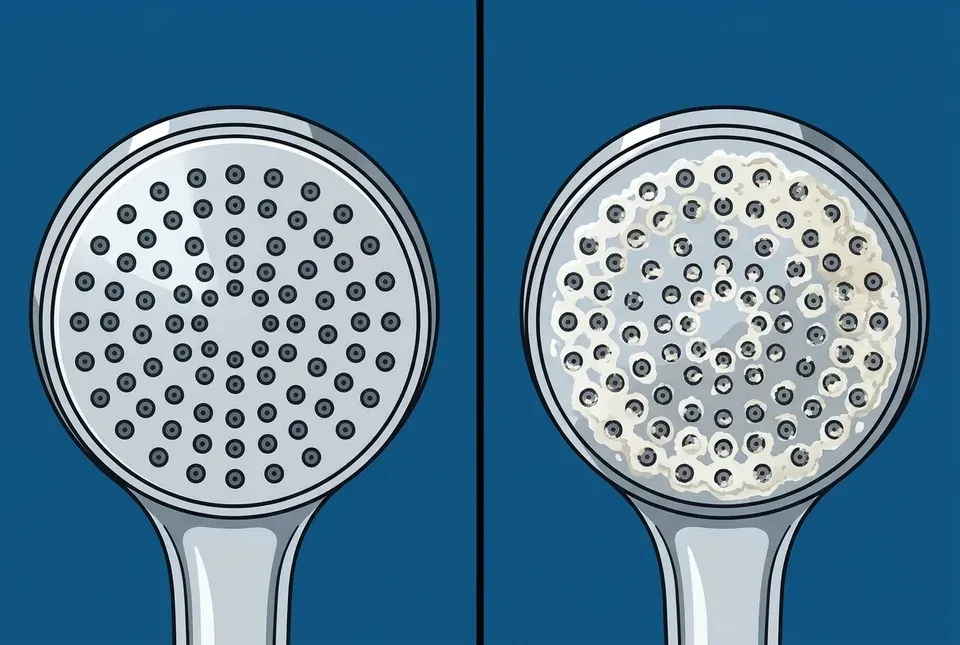
The best place to look is a showerhead face. Scale collects around the individual holes, and on an older head you will see the spray pattern go crooked as some of them close down. A faucet aerator tells the same story faster: unscrew it, and if hardness is meaningful, the screen has white grit sitting on it.
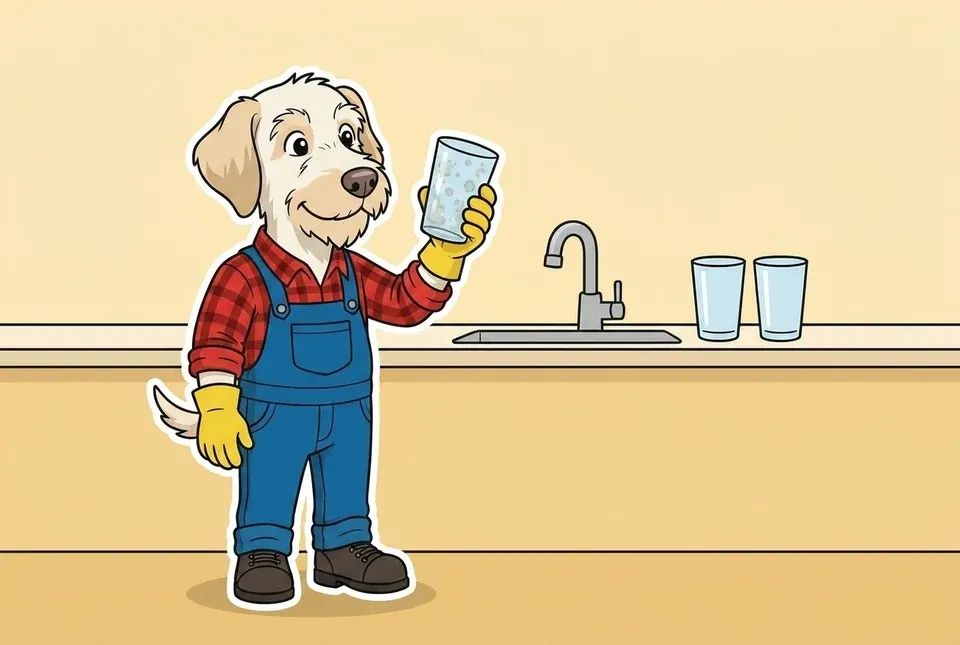
Glassware is the other reliable tell, and it is worth knowing the test. Take a cloudy glass and put a little white vinegar on it for a few minutes. Mineral film dissolves and the glass clears. Etching, which is permanent damage from a hot dishwasher and too much detergent, does not change at all. That single check tells you whether you have a water problem or a dishwasher-settings problem, and they get confused constantly.
Why Does Soap Fail to Lather in a Manassas Home With Hard Water?
This one is chemistry rather than housekeeping. Soap works by grabbing oils, but the calcium and magnesium in hard water grab the soap first. The reaction ties up the soap into an insoluble curd before it can do its job, which is why you get less lather from the same amount and why the residue it leaves is sticky rather than rinsing away.
That residue is soap scum, and it is genuinely a different substance from limescale even though they turn up in the same places. Scum is the soap-and-mineral compound, it is softer, and it smears. Scale is the mineral alone, left behind by evaporation, and it is hard. A bathroom in a hard-water house usually has both, in layers.
The practical consequence is that you end up using more product to get the same result, in the shower, at the sink and in the washing machine. Laundry is where it is easiest to miss, because the symptom is not dirt but stiffness: fabric that dries scratchy has mineral and soap residue left in the fibers.
Which Hard Water Signs Show Up on Appliances in a Manassas Home?
Anything that heats water concentrates the evidence, because heating drives the minerals out of solution faster than evaporation alone. What you are looking for is deposit, and you can usually see it without tools.
A kettle is the clearest window: a white or gray crust on the element and the base, sometimes flaking loose into the water. A coffee maker slows down and the cycle takes longer than it used to. A dishwasher leaves that cloudy film on everything and the spray-arm holes collect grit the same way a showerhead does. On a washing machine, hardness shows up as residue in the drum and detergent that never seems to be enough.
We are deliberately not going to tell you what that costs an appliance in service life here. It is a real question with a real answer, and we give it the space it deserves in how long a water heater lasts in a Stafford home rather than compressing it into a paragraph. For this article the point is narrower: deposit you can see on the outside is the same deposit forming where you cannot.
How Do You Find the Water Hardness Number for a Manassas Address?
Here is where you can stop guessing, and it is the part almost no national article offers, because hardness is local and they cannot be. Your water utility publishes its own numbers, and in this region they are genuinely different from one another.
Hardness is measured in grains per gallon, and the classification scale Prince William Water publishes runs: under 1.0 grains per gallon is soft, 1.0 to 3.5 is slightly hard, 3.5 to 7.0 is moderately hard, 7.0 to 10.5 is hard, and above 10.5 is very hard. Once you know the scale, a number means something.
Two nearby utilities show how much it varies. Fairfax Water reports its supply as “moderately hard” to “hard” at 5 to 10 grains per gallon, or 84 to 170 milligrams per liter, drawn from the Potomac River and the Occoquan Reservoir, and notes it can vary with location and rainfall. Prince William Water goes further and publishes a system-by-system table: its East and West systems and the Carter’s Grove system run 3.5 to 7.0 grains per gallon, classified moderately hard, while the Bull Run Mountain and Evergreen system and the Hoadly Manor system run 7.0 to 10.5, classified hard. One utility, four named systems, two different classifications.
The City of Manassas runs its own water system and its own treatment plant, separate from both, so neither of those tables is your answer if you are a city customer. What you want is the city’s own annual drinking water report, published every year. If you are on a private well, no utility is reporting anything about your water and a test is the only way to know.
One thing worth knowing before you go looking: there is no federal limit to compare your number against. Prince William Water spells this out, noting the EPA sets primary standards based on health and secondary standards based on things like taste and color, and that there is no primary or secondary standard for water hardness at all. Hardness is an equipment and housekeeping question, not a safety one.
When Do Mineral Deposits Tell a Manassas Homeowner to Add a Softener?
The signs above tell you hardness is present. They do not, on their own, tell you it is worth treating, and the honest threshold is lower than a softener salesman would like and higher than a single spotted glass.
The case gets strong when the evidence is persistent rather than occasional: scale returning on fixtures within days of cleaning, deposit visible inside appliances, laundry consistently stiff, and a published or tested number in the hard or very hard bands rather than the moderate one. One or two of those is a housekeeping annoyance. All of them together is a house steadily depositing minerals into everything that heats or carries water.
What we will not do is size or specify equipment in a blog post. Softener selection depends on your actual hardness number, your household’s water use and what else is in the water, which is exactly why our own water quality service starts with a test rather than a recommendation. The point of this article is to get you to the test knowing what you are looking at.
How Do You Tell Hard Water From Other Water Problems in a Manassas Home?
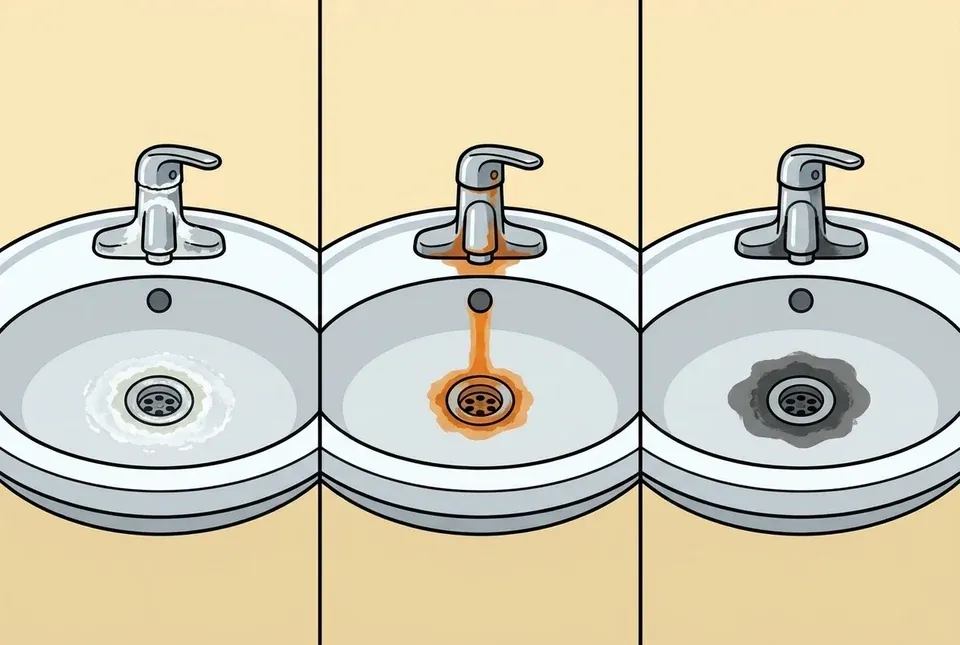
This is the section that saves people money, because the most expensive mistake in household water is treating the wrong problem. Hardness, iron and sediment leave different marks, and the giveaway is usually color.
Hardness is white. Chalky, pale, building in layers, worst where water dries.
Iron is orange, red or rust brown, and the confusing part is that the water often looks perfectly clear coming out of the tap. Dissolved iron is invisible until it meets air. As a commenter explaining this in a water-treatment forum put it, soluble iron is invisible, and the problem starts when the water is exposed to air and the oxygen turns it into iron oxide. That is why a clear glass of water can still leave an orange ring in a toilet tank, a sink, or a washing-machine drum. A related tell is a slimy orange film in tanks and other places water sits still, which points at iron bacteria rather than minerals.
Manganese is black or gray rather than orange, which is a useful separator when a stain is dark instead of rusty. And sediment is simply particles, grit you can feel on an aerator screen or see settle in a glass.
Why the distinction matters in money terms: a water softener is built for hardness, and it does relatively little for iron beyond small amounts. One homeowner in a water-treatment forum described exactly that bind. Their well tested at 7.0 hardness and 2.5 iron, everything in the house was turning orange, and they noted that the softener they already owned had been checked and was operating well, it just was not making a difference. The most-upvoted reply was blunt: at those readings the assumption should be the iron rather than the hardness, and a softener would not help with that much of it. The machine was working. It was the wrong machine for the problem, and a test in advance is what prevents that.
The Bottom Line on Hard Water in Manassas
Hard water announces itself in white: chalky scale where water dries, cloudy glassware, soap that will not lather, deposit inside anything that heats water. None of it is a safety problem, and there is no federal standard for it, but it is real and it is persistent, and scrubbing is not a strategy.
The two things worth doing are cheap. Look up what your own utility publishes, because the number varies system by system even inside one county and the City of Manassas is separate again. And check the color of whatever is staining before you buy anything, because white, orange and black point at three different problems and only one of them is answered by a softener.
If you would rather have a number than an impression, we test and explain what we find before recommending anything, which is how we prefer to work on a system that touches every fixture in the house.