Can Your Fairfax Electrical Panel Handle an EV Charger?
Most articles about home charging start with which charger to buy. That is the second question. The first one is whether the panel in your garage or basement can carry another large circuit at all, because if it cannot, the charger you picked is irrelevant until that is solved. The good news is that a homeowner can get most of the way to an answer without tools, just by reading what is already printed inside the panel door and counting what is in there. This article is how to do that, and what a licensed electrician checks after you. If you would rather start with the answer, EV charger installation in Fairfax begins with exactly this assessment. Our family has been working in Northern Virginia homes since 1956.
How Do You Check the Amperage of a Fairfax Electrical Panel?
Start with the single most useful number in the house. It is easy to find. The EPA’s own guidance is to look at your primary electrical panel’s main switch, typically the largest switch at the top, where the number stamped on it represents the total amps your home can provide.
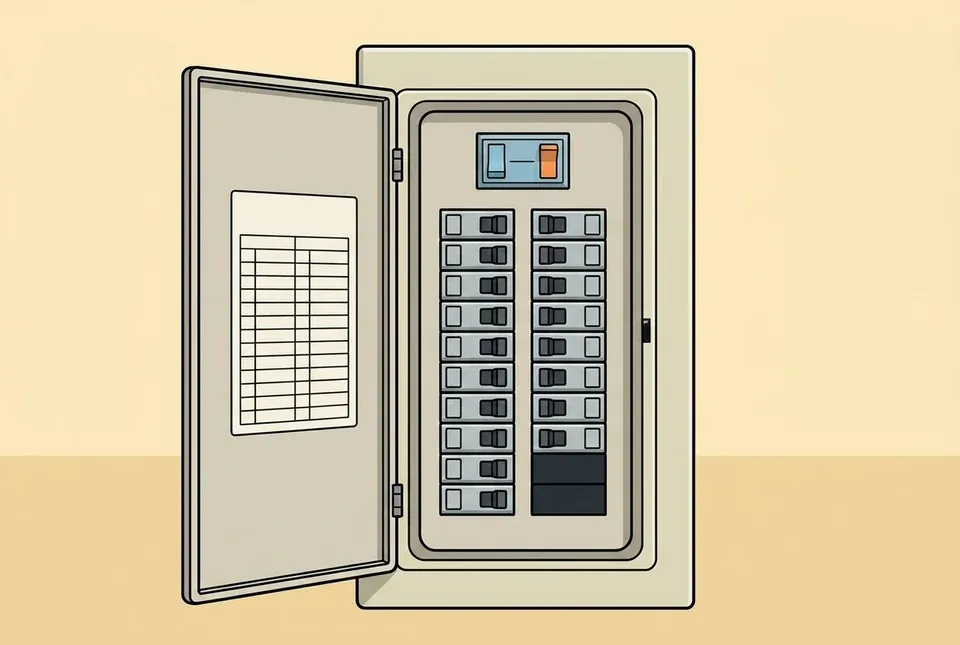
Open the panel door, the outer cover with the hinges. You do not need to remove the inner cover, and you should not: it is the boundary between homeowner territory and licensed work. The main breaker is usually a single large switch at the top, physically bigger than the rest and marked with a number, almost always 100, 150 or 200.
Fairfax County’s housing stock spans a lot of decades, and the number follows the decade fairly reliably. The EPA notes that older homes usually have 60 or 100 amps, while homes built around the 1980s or later tend to have 200 amps or more. So a 1960s rambler and a 2005 colonial start this conversation in different places, and the older house is where the question actually gets interesting.
Write the number down. Everything else in this article refers back to it.
How Do You Install a Dedicated Circuit for a Fairfax EV Charger?
The short version is that you do not, and neither does any homeowner. Installing a new 240-volt circuit is licensed work, pulled on a permit and inspected. What is worth understanding is what that circuit is, because it explains the demand on your panel.
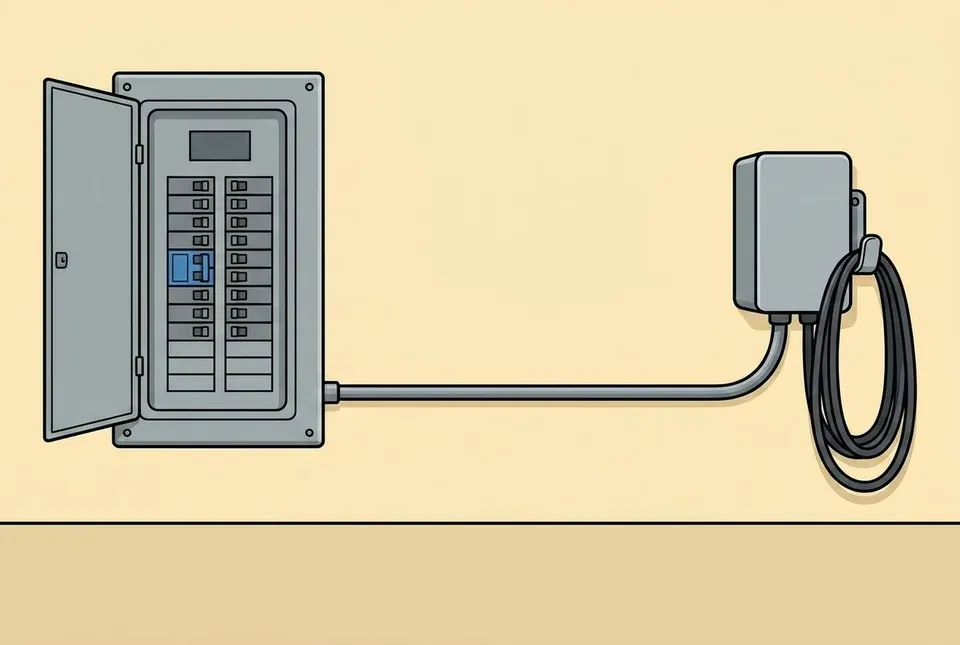
A Level 2 charger runs on 240 volts, which is the same supply an electric dryer or range uses. The EPA describes home units as typically ranging from 16 to 80 amps, with 30 to 40 amps being more common. That circuit is dedicated, meaning it serves the charger and nothing else, and it lands on a double-pole breaker, which occupies two slots in your panel rather than one.
There are two ways it terminates. Many installations use a NEMA 14-50 receptacle, the same style used for ranges, and the charger plugs into it. Others are hardwired directly. The EPA notes that chargers rated at 48 amps or higher are usually required to be hardwired rather than plugged in, so the higher you go, the less optional that becomes.
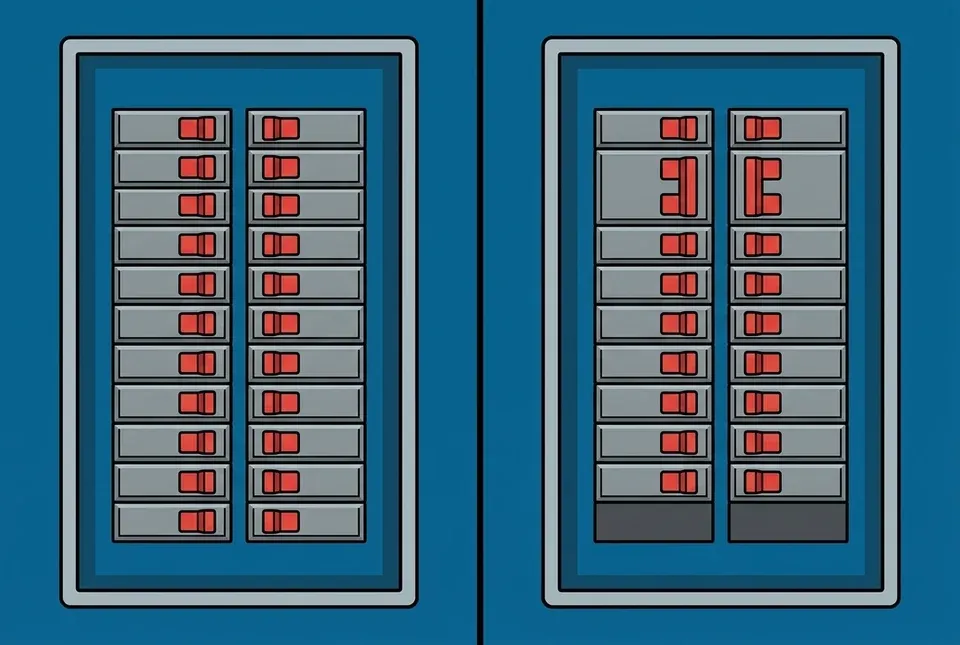
The reason this matters for the panel question is the double-pole breaker. It is not one space. It is two, side by side, on the same side of the panel, which is a stricter requirement than “is there a gap somewhere.”
What Load Calculation Steps Decide If a Fairfax Panel Can Add a Charger?
A load calculation is the formal answer to “can it carry this,” and it is the step that turns your reading of the panel into a decision. The EPA lists it first among what to expect from an electrician: performing a load calculation to determine whether your existing panel can handle an EV charger, or whether upgrades are needed.
It adds up the demand your home is designed to draw, by a method the electrical code defines rather than guesswork. Square footage sets a baseline for lighting and general receptacles. Then fixed appliances are counted: range, dryer, water heater, air conditioning, heat pump, anything on its own circuit. The code applies demand factors, because a house never runs everything at once, and the result is compared against the service size you wrote down.
If the result leaves enough headroom for the charger’s circuit, the answer is yes. If it does not, the answer is one of the alternatives rather than a flat no.
There is a free step to take first. Your electric utility holds your actual consumption history, often hour by hour, and homeowners in EV forums use it routinely. One with 100-amp service pulled a year of hourly data and found their highest hour was a fraction of capacity. Another noticed none of their peak hours were overnight, which is when a car would charge. That does not replace a load calculation, which is a code exercise rather than a measurement, but it tells you which conversation you are likely to be having.
Does a 100 Amp Fairfax Panel Have Room to Install an EV Charger?
Often, yes. This is where the internet is more pessimistic than the evidence supports.
The EPA’s position cuts against the common assumption, so here it is in full: a home with at least 200 amps and two empty slots for a double-pole breaker likely has capacity for a Level 2 charger, and even 100-amp service is often sufficient, depending on how much electricity the other appliances use. The Department of Energy makes the same point from the other direction, noting that while some homes have insufficient capacity for Level 2 equipment, a qualified electrician can add circuits to accommodate what is needed.
What decides it in a 100-amp house is what else is electric. A home with gas heat, a gas range and a gas water heater is using far less of its service than an all-electric one, and it has correspondingly more room. That is common in older Fairfax neighborhoods, and it is why a 1960s house on 100 amps is frequently a better candidate than people expect.
When headroom really is short, the alternatives come before a service upgrade. The EPA lists two: use a lower-powered charger, since a smaller unit draws less and may still cover your daily driving, or ask about load management systems that share capacity between the charger and other appliances. There is also a sub-panel route. Which of those fits is a question for the person doing the load calculation, and our electrical panel service is where that decision gets made rather than here.
How Do You Count the Free Breaker Slots in a Fairfax Electrical Panel?
Here is the distinction almost nothing published on this topic makes, and it is the one that will save you a wasted conversation.
“No room” means two completely different things. It can mean no physical slots left in the panel to put a breaker in. It can mean no electrical capacity left on the service. These are separate problems with separate solutions, and having one does not tell you about the other. A panel can be physically full while the load calculation shows plenty of headroom, and a panel with four empty slots can be maxed out electrically.
Two separate online discussions are unusually clear on this. The most-upvoted answer in an electricians’ thread put it directly: just because there are no slots in your breaker panel does not mean you cannot add power for a charging station, and if the capacity is available, tandem breakers can open up slots to get the space you need, but the load calculation still has to be done. The top answer on a separate thread said the same thing independently, that lower-load breakers can sometimes be replaced with compact ones to make room, while the overall load calculation still has to confirm capacity.
Tandem breakers, sometimes called compact or twin breakers, fit two circuits into the space of one. Not every panel accepts them, and not every position within an accepting panel does, which is printed on the panel’s own label. That label is worth reading while you count.
So count two things. How many empty positions are there, and are any two adjacent on the same side, since a double-pole breaker needs a pair. And separately, does the panel accept tandems. Circuits genuinely no longer used can sometimes be reclaimed too, which is an electrician’s job rather than a weekend one.
Which Permits Should a Fairfax Homeowner Check Before Installing an EV Charger?
Assume a permit and an inspection, because that is the normal case rather than the exception. The Department of Energy states that charging installations must comply with local and state codes, that permits may be required from the local building and permitting authorities, and that in many areas a site installation plan has to be submitted for approval before work begins. The EPA says the same in its list of what to expect from an electrician.
In Fairfax County, permits and inspections for residential work run through Land Development Services, and that is the authority to check against for your address. It is worth confirming rather than assuming, because the City of Fairfax and the City of Falls Church run their own permitting separately from the county, and which one applies depends on where you actually live rather than on your mailing address.
The practical point is simpler than the process. A contractor who offers to add a 240-volt circuit without a permit is offering to leave unpermitted electrical work in your house, which is a problem at resale and with your insurer. Ask who is pulling it. The answer should be immediate.
How Do You Protect a Fairfax EV Charger Circuit From Overload?
The protection is designed into the circuit rather than bolted on afterwards. The rule behind it explains a number that otherwise looks like padding.
Car charging is treated by the National Electrical Code as a continuous load, meaning it runs at close to its full draw for hours rather than in short bursts. The Department of Energy states this directly and points to NEC Article 625 as covering charging equipment. Continuous loads are sized with a margin, which is why the EPA’s guidance is that the breaker should be rated at least 125 percent of the charger it serves, so a 40-amp charger needs a dedicated 50-amp circuit, citing NEC Article 625.41.
That margin is the overload protection. It is also why a charger’s amperage and its circuit’s amperage are different numbers, and why “a 40-amp charger on a 40-amp breaker” is wrong in a way that matters.
Two other things belong on the list. Choose a charger that carries a safety certification from a recognized testing laboratory rather than an uncertified one, which both the EPA and the Department of Energy recommend. And if your panel is a Federal Pacific or Stab-Lok, capacity is not your first problem: independent and contracted testing has recorded breakers that failed to trip, with no government finding and no recall behind it, and we cover what that record actually says separately. That question gets settled before anything gets added.
The Bottom Line on EV Charger Panel Capacity in Fairfax
You can answer most of this yourself in ten minutes. Read the main breaker and write the number down. Count the empty positions and note whether any two are adjacent. Check whether the panel label allows tandem breakers. Pull your hourly usage from your utility.
Then hand it over, because the load calculation, the permit and the circuit are licensed work. A 100-amp panel is not a no. A physically full panel is not a no either. The only real no is a load calculation that comes up short, and even then the fix is usually smaller than a service upgrade.
If you want that assessed properly, we do the calculation before we quote the work, which is how we would rather do it than find out halfway through.