Replace the Evaporator Coil or the Whole AC? How to Make the Right Call
Quick answer
If your evaporator coil is leaking and your AC is under about 8 years old, uses R-410A, and matches your outdoor unit’s efficiency, replacing just the coil usually makes sense. If the system is older, uses R-22, or the coil is discontinued, you’re almost always better off replacing the whole unit. The reason is a word HVAC techs use a lot: matching. A mismatched indoor and outdoor unit quietly wastes the money you spent to fix it.
Here’s how to think it through before you sign off on either repair.
What the evaporator coil actually does
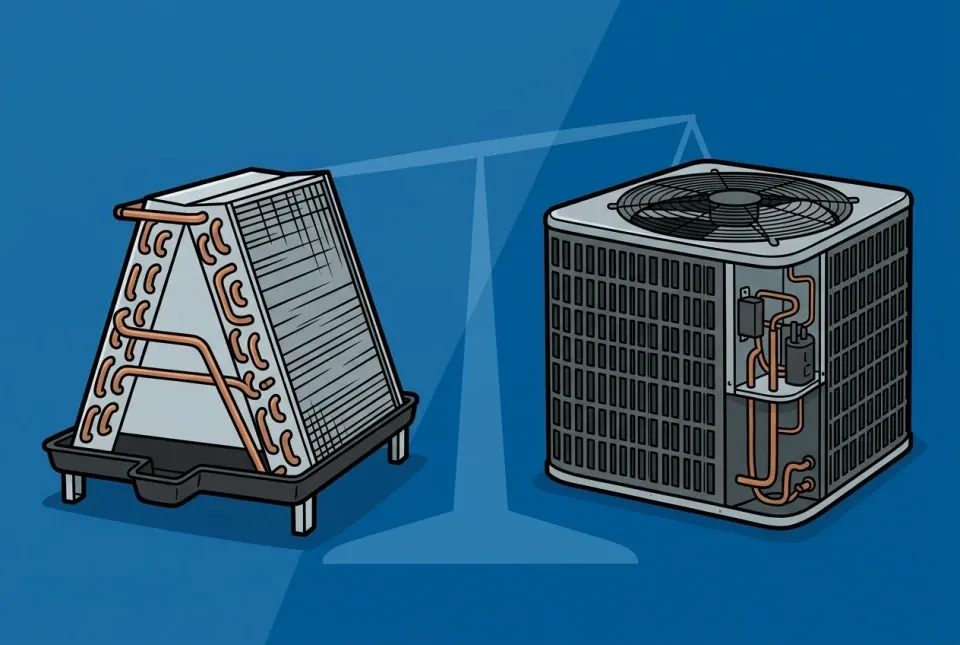
Your AC has two coils. The evaporator coil sits indoors, usually on top of or inside your furnace or air handler. The condenser coil lives in the outdoor unit. They’re separate parts, but they’re a matched pair engineered to work together.
The evaporator coil is where the cold happens. Refrigerant flows through it, absorbs heat and humidity from the air blowing across it, and carries that heat outside to be dumped. Your AC doesn’t “make” cold air the way a furnace makes heat, it moves heat out of your house. No working evaporator coil, no cooling.
Why evaporator coils fail
The number-one killer is a refrigerant leak, and the usual cause is formicary corrosion: microscopic pinhole leaks that form when the copper reacts with everyday household chemicals in the air (cleaners, air fresheners, new carpet and paint off-gassing). NoVA’s humidity doesn’t help.
You can’t see these pinholes. What you notice instead is the fallout: weak cooling, ice on the copper lines, runtimes that never end, and a system that’s low on refrigerant again a few weeks after a top-off. Once a coil is leaking, patching it rarely holds. Replacing the coil is the honest fix.
When to replace just the coil
Swapping only the evaporator coil is the smart, cheaper move when all of these are true:
- Your system is roughly 8 years old or newer. It still has most of its useful life ahead of it.
- It uses R-410A refrigerant (any AC installed in NoVA in the last decade-plus does).
- A matching coil is still made for your outdoor unit’s efficiency rating.
In that case you’re putting a fresh part into a system with plenty of road left.
Typical cost: $650 – $2,000 installed, depending on coil size, whether it’s cased or uncased, and how much refrigerant the system needs afterward.
When to replace the whole system instead
1. The system is 10+ years old
Most AC systems in our area run well for about 12–15 years. Once yours is past 10, dropping a brand-new coil into an aging system is like putting a new engine in a car with a worn-out everything-else. The compressor, the outdoor coil, and the fan motors are all heading toward the end at the same time. You’d be paying twice.
2. Your AC uses R-22 refrigerant
R-22 (Freon) was banned from production and import in the U.S. in 2020. Only recycled and stockpiled supply is left, and the price has climbed accordingly. If your leaking coil is on an R-22 system, you can’t simply match it with a new R-22 coil worth buying, and any repair means paying premium prices to recharge a system that will leak again. This is almost always the moment to replace the whole unit with an R-410A (or newer R-32/R-454B) system.
3. The new coil would mismatch your outdoor unit
This is the one homeowners miss. If you pair a new high-efficiency evaporator coil with an older, lower-efficiency condenser (or vice versa), the weaker half drags the whole system down. You paid for efficiency you’ll never see, and mismatched systems tend to run harder, cost more to operate, and fail sooner. Modern efficiency standards (Northern Virginia falls under the federal minimum of SEER2 14.3 for new systems) also mean an exact-match replacement coil for a 12-SEER unit from 2009 may simply not exist anymore.
The rule of thumb we actually use
Multiply the repair cost by the system’s age in years. If that number is bigger than the cost of a new system, replace. A $1,200 coil on a 4-year-old unit ($4,800) is an easy repair. That same coil on an 11-year-old R-22 system ($13,200, plus expensive refrigerant) is an easy replacement.
Age, refrigerant type, and matching, in that order. When those three point the same direction, the decision makes itself.
How to make coils last
You can’t stop corrosion entirely, but you can slow it down:
- Change your filter on schedule so the coil stays clean and airflow stays strong.
- Get a spring tune-up. A tech checks refrigerant charge and catches a small leak before it starves and stresses the system.
- Keep harsh chemical fumes away from the return-air area near the indoor unit when you can.
- Never keep running an AC that’s iced up or clearly low on refrigerant. That’s how a coil problem becomes a dead compressor.
When to call a pro
A leaking coil isn’t a DIY fix, and neither is the repair-versus-replace math. Refrigerant work is legally restricted to certified technicians, and the right call depends on details you can’t eyeball: actual charge, coil availability, and the true condition of your outdoor unit. What you can do is ask for both numbers up front: the honest coil-only repair price and the replacement price, side by side.
Not sure whether your coil or your whole system is the smarter fix? Leonard Splaine has served Northern Virginia families for three generations, and we’ll give you the straight repair-or-replace math before you spend a dime. Call 703-494-2855 or request service online.