How to Find a Refrigerant Leak in Fairfax
Finding a refrigerant leak is a process of elimination run in a deliberate order, and it starts with proof rather than a hunch. A technician confirms the charge is genuinely low with a gauge reading or a charge weigh-in, then works the system from easiest access to hardest: the service valves and their Schrader cores, then the condenser, then the line set and its brazed joints. The tools are an electronic leak detector, a nitrogen pressure test, and UV dye. Your AC does not consume refrigerant, so a low charge means something is letting it out, and that has a physical location. Real AC repair in Fairfax starts with finding it, not with topping the system off.
One caveat first. Inside an evaporator coil, a leak is often several microscopic holes rather than one you can seal, and chasing those really is a needle in a haystack. That futility lives inside the coil. This post is about everywhere else, and those leaks are findable.
How Do You Confirm a Fairfax AC Has a Refrigerant Leak?
You confirm it with a measurement, not a symptom. The tells homeowners notice, cooling that fades over weeks, ice on the line set, an oily film near the outdoor unit, all point to a low charge, but unrelated faults look identical from the hallway, which is why the broader list of reasons a system stops cooling is worth ruling out first.
Measured evidence comes in two forms. The first is a gauge reading taken while the system runs, compared against the pressures and temperatures the manufacturer specifies for that outdoor temperature. On a Fairfax afternoon in the low nineties, an undercharged system gives itself away. The second, and the one that settles arguments, is a charge weigh-in: recover the refrigerant into a recovery machine, weigh what came out, and compare it to the factory charge on the equipment’s data plate. That number is not open to interpretation.
Your AC does not burn refrigerant the way an engine burns oil. It is a sealed loop that should hold one charge for its whole life, so a system that is low is a system that is leaking. The only question left is where.
How Do You Check the Service Valves and Cores for Refrigerant Leaks?
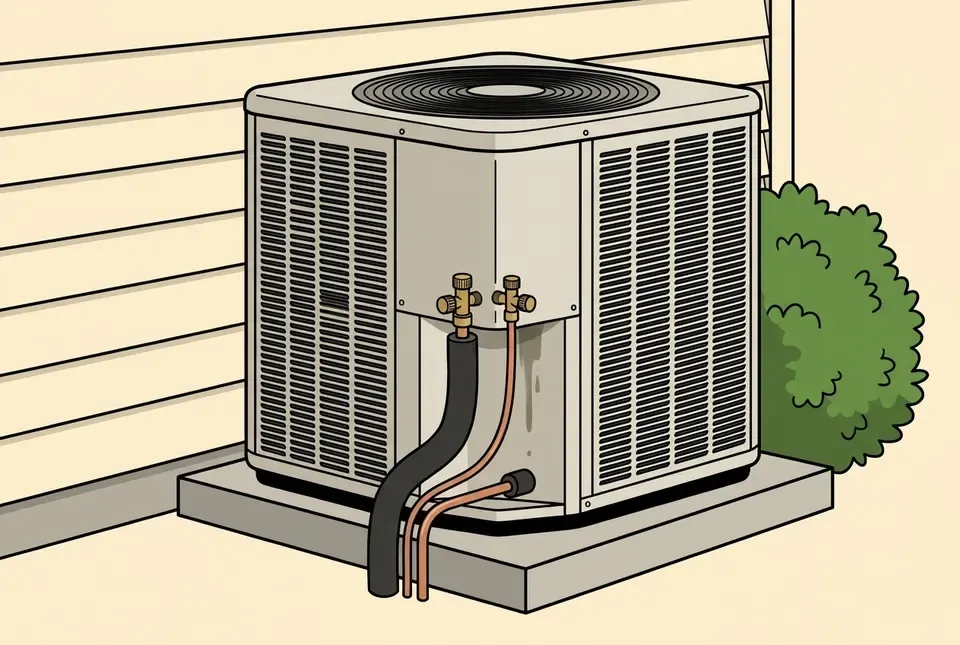
The service valves get checked first: they are one of the more common leak points outside the coil and the fastest to rule out. Each valve carries a Schrader core, the same spring-loaded valve as the one in a car tire, and it fails the same ways: a core backed off slightly, a worn O-ring, or one that never reseated after the last service call. A leaking core can often be swapped without recovering the whole charge.
A service cap is a second seal, not a dust cover, and a bare port is down to one line of defense. Caps left off are a known slow-leak risk, which is why replacing them is one of the small things a seasonal maintenance visit takes care of.
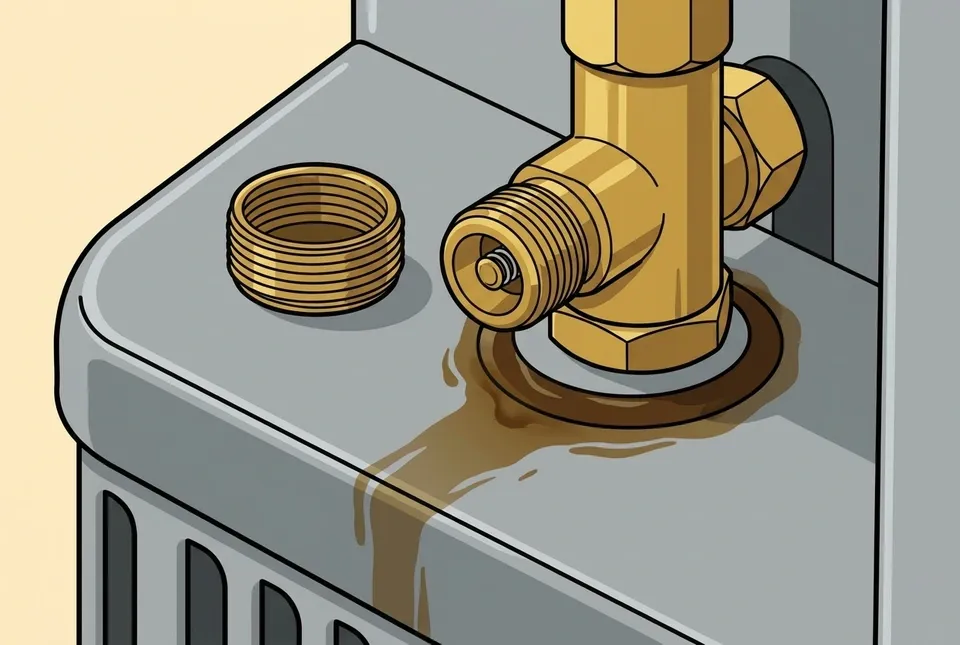
Here is what you can safely do yourself, and it helps: stand back and look. A missing or loose cap on either service port is worth noting. So is an oily, dirt-caught smudge around a port or fitting, because escaping refrigerant carries compressor oil with it and that oil stays behind. So is an audible hiss near the outdoor unit. Photograph it, note where you saw it, and hand that over. Those three observations regularly cut a search short.
Here is where it stops. Do not press a valve core, do not pull a cap off to check, and do not attach gauges. Refrigerant leaving a port under pressure is cold enough to cause frostbite and burns on contact, which is what Poison Control, the National Capital Poison Center, describes for skin exposure. It treats swallowing, skin contact and inhalation all as routes of harm, and it is measured about the last one: inhaling a small amount from a leak is probably not harmful and should not lead to long-term effects, while breathing a concentrated amount is serious. The hazard is concentrated exposure, not the trace around a slow leak. Beyond that, this is certified work: EPA regulations under Section 608 of the Clean Air Act require technicians who service, repair, or dispose of equipment that could release refrigerants to be certified, and that covers today’s refrigerants too.
Should You Check the Condenser or the Line Set First at a Fairfax Home?
Condenser first, line set last, and the reason is access rather than probability. The condenser sits outside in the open where a technician can walk around it, sweep a detector across the coil face and the brazed joints inside the cabinet, and rule it in or out in minutes. Condenser leaks are less frequent, but they move fast, because the condenser carries the highest pressures in the system. A useful rule of thumb: a charge that vanishes in days points toward the high-pressure side, while one that quietly drops over a season points toward the low side.
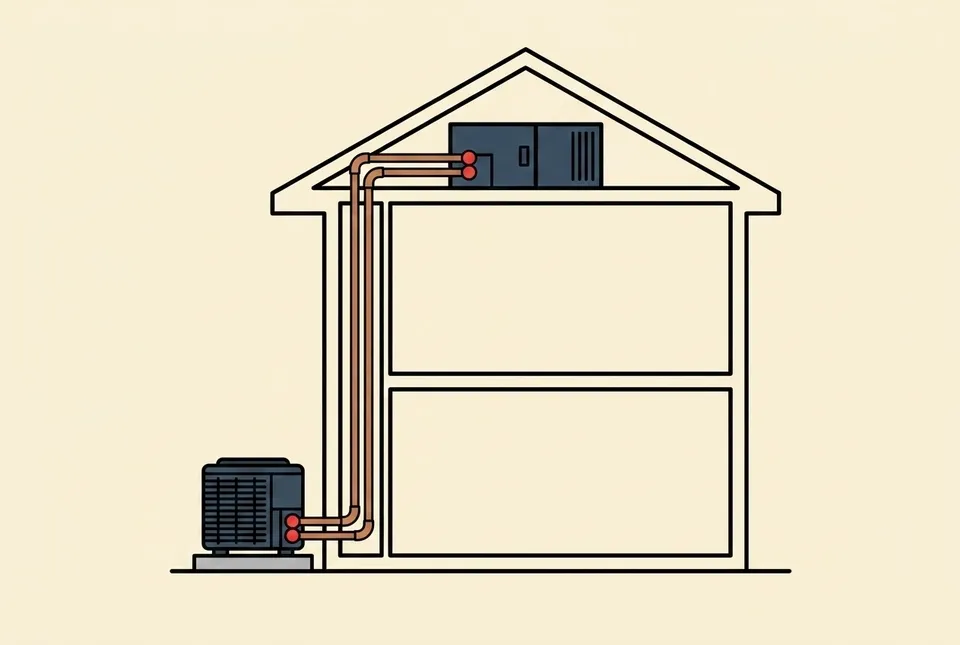
The line set comes last because it is the hardest part of the system to reach. In most Northern Virginia houses the copper runs through a chase, an attic, or above a finished ceiling, whether that is a colonial in Fairfax or one of the homes we service in Springfield. Line sets fail three ways: punctures from a nail or screw driven during roofing, siding, or a remodel; rub-outs, where a line spent years vibrating against a joist until it wore through; and kinks left at installation. None of that is visible from the yard, which is why the pressure test exists.
How Does a Technician Pressure Test a Fairfax Home’s AC for a Leak?
By taking the refrigerant out, putting dry nitrogen in, and watching whether the pressure holds. The refrigerant is recovered first, because you cannot test a system through the gas you are trying to measure. The technician then isolates one section, the line set on its own, say, cut off from the condenser and the evaporator, and pressurizes only that section with pure nitrogen, which on a line set alone can go as high as 400 psi.
Then comes the waiting. A fifteen-minute hold proves very little, because a slow leak needs time to move a needle. An hour is a truer test, and a stubborn case can justify holding overnight. Whichever isolated section loses pressure is the one with the leak, and a spray bottle of soap solution along its joints turns “somewhere in here” into a specific fitting blowing bubbles. This is why a leak that “cannot be found” usually means one that has not been searched for properly.
How Does UV Dye Find an AC Leak an Electronic Detector Misses?
Dye works on time, while an electronic detector only works in the moment it is held there. A detector, what the trade calls a sniffer, samples the air at a suspected spot and alarms on refrigerant molecules. There is real art to using one, and it has blind spots: a breeze across the condenser disperses the sample, and a slow enough leak may never build a concentration big enough to trip it. Some leaks simply cannot be found with a sniffer.
UV dye solves that by being patient. It circulates with the compressor oil, so wherever refrigerant escapes, a little oil and dye go with it, and unlike the gas, the dye stays put. Under a UV lamp it glows at the exact exit point, sometimes weeks or months after the visit that added it. The tradeoff is a waiting game plus an additive in a sealed system, so it is not our first move. It is what we reach for once the detector, the bubbles, and the pressure test have come up short.
Why Is a Fairfax Refrigerant Leak Search Billed Apart From the Repair?
Because the search and the repair are two different jobs, and only one of them has a knowable size. Fixing a leak is a defined task once you know what and where: replace the core, braze the joint, section the line. Finding it is open-ended labor plus equipment, a recovery machine, a nitrogen cylinder, a detector, sometimes dye and a lamp, over a duration nobody can promise up front. Folding that into one repair price forces a contractor to either pad every quote or eat the hard cases. Pricing it separately puts the decision in your hands.
The published numbers reflect that split. National figures compiled by HomeGuide put an AC leak test at $100 to $330 for detection only, and a general AC service call to diagnose a problem at $75 to $200. Refilling the refrigerant after the repair runs $100 to $320 on R-410A. End to end, finding the leak, fixing it, and recharging the system lands at $200 to $1,500 in that same data, with a national average around $800. Those are national ranges gathered by a third party, not our pricing, and they are wide for a reason: a loose Schrader core found in ten minutes and a line set buried above a finished ceiling are not the same job.
So ask what a leak search costs before it starts, and ask for it as its own number.
Should You Stop a Fairfax AC Recharge Before the Leak Is Found?
Yes. Find first, then decide. Refrigerant put into a leaking system leaves the same way the last charge did, and we have made that case elsewhere on this blog: here is what topping off a leaking system actually costs you when nobody looks for the hole first.
What the search adds is the part that changes your decision. A leak at a Schrader core, a service valve, or a line-set fitting is usually repairable on the spot, and once that repair is made, a recharge is exactly the right next step. A confirmed leak inside the evaporator coil is a different conversation with a different answer, and that one belongs to the coil post linked above. You cannot know which case you are in until the search is done.
One middle case is worth naming: sometimes a thorough search comes up empty. A straight-shooting technician will say so plainly and lay out the real options: recharge and monitor it, search again when it drops, or step back and look at the system as a whole. What should not happen is a quiet recharge sold to you as a repair, followed by the same phone call a few weeks later.
A refrigerant leak is not a mystery, it is a search. Confirm the charge is genuinely low with a gauge reading or a weigh-in. Check the service valves and Schrader cores first, then the condenser, then the line set, escalating from detector to soap bubbles to a nitrogen pressure test to UV dye. Treat the search as its own job worth paying for, and never let a leaking system get recharged without someone telling you where the refrigerant is going.
If your Fairfax home is cooling weakly and you suspect the charge is low, we can find out. We have done this work in Northern Virginia since 1956, third generation, family owned, and not private equity, and we would rather find your leak than sell you a refill. That is how we work and what we stand behind.