How Often to Service Your AC in Lorton
Ask how often an air conditioner needs servicing and you will get the same answer everywhere: twice a year. That answer is right, and it is also the least useful part of the conversation. The interesting question is not how often somebody comes out. It is what actually happens while they are there, because a maintenance visit is the one home service where you pay for work you cannot see and mostly cannot verify. Our family has been doing this across Northern Virginia since 1956, and we would rather explain what a real visit looks like than sell you a sticker on the side of your furnace. If you are weighing up AC maintenance in Lorton, the checklist below is what you are actually buying.
How Do You Decide How Often a Lorton AC Needs Servicing?
Twice a year is the baseline everyone agrees on, and there is a reason for it. Most Lorton homes run one system that both cools in summer and heats in winter, so it gets inspected ahead of each season it has to survive.
If your cooling and heating are separate systems, or you have a heat pump running year round, the honest answer shifts. A heat pump works in both seasons and earns two visits on its own merits. A system used only for cooling can often be looked after once a year, before summer.
Three things push you toward more attention rather than less. Age is the obvious one, since a system past a decade has more parts drifting out of tolerance. So is a system that has already had a repair this year, because the conditions that caused it usually have not gone anywhere. And so is a manufacturer warranty, because many require documented annual professional service to stay valid, and a claim is a bad moment to discover yours lapsed.
What you cannot judge from the thermostat is the part that matters. A capacitor can be running well below its rated tolerance and still start the compressor every time, right up until the afternoon it does not. Measuring that is not something a homeowner can do, and it is a large part of why the visit exists.
What Does a Real AC Tune Up Checklist Include for Lorton Homeowners?
There is an actual national standard for this, which surprises most people. The Air Conditioning Contractors of America maintains ANSI/ACCA Standard 4 QM, and the reason it exists is worth quoting, because it is essentially the thesis of this article. ACCA wrote that there was no way to determine whether the many types of seasonal tune-ups and clean-and-checks performed on HVAC equipment were equivalent, so the standard sets out the minimum tasks a maintenance inspection should include. The Department of Energy’s own building science training materials point at that same ACCA standard, as does Pacific Northwest National Laboratory.
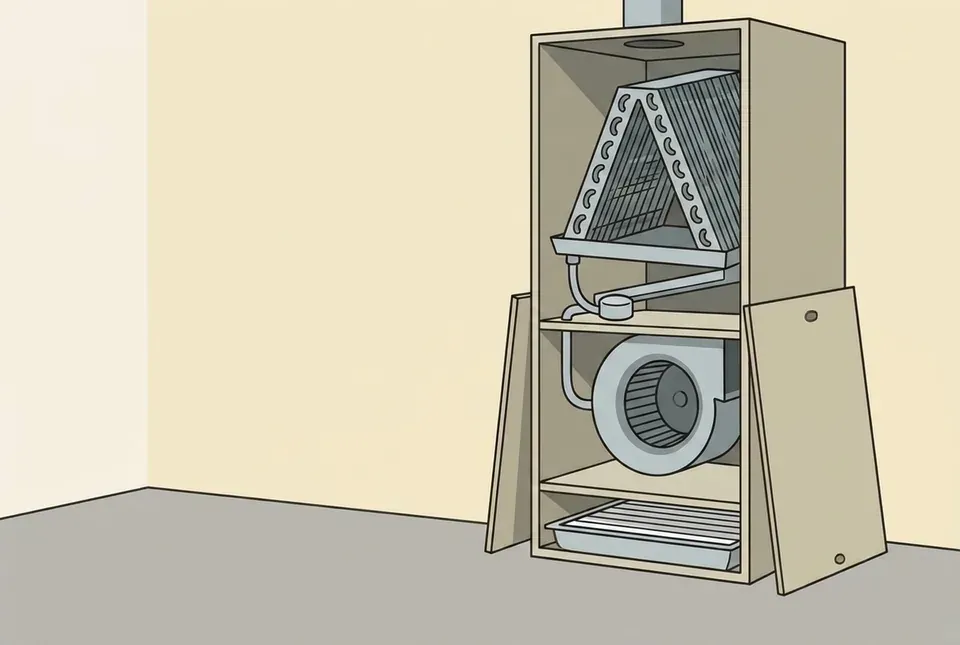
In practice, a visit worth the name covers the coils at both ends, cleaned rather than glanced at. Refrigerant pressures and temperatures measured against what the system is rated for, not assumed. Capacitors and contactors tested, with actual readings. Electrical connections checked and tightened. The condensate drain cleared and treated. The blower wheel and motor inspected and cleaned. The thermostat verified against real conditions. On the heating side, the heat exchanger, burners and flue.
ENERGY STAR’s own maintenance checklist covers much of the same ground. The point of naming them is not to impress you. It is that when independent bodies keep publishing overlapping lists of what the job actually contains, “we had a look at it” is not a defensible interpretation of it.
How Do You Tell If a Lorton AC Was Actually Serviced or Just Looked At?
This is the part nobody in our industry likes to write down, so here it is.
Time is the bluntest signal. A genuine two-system inspection with coils cleaned and readings taken does not finish in thirty minutes. If someone was in and out of your Lorton home in under an hour and the air handler was never opened, you did not get a tune-up.
Ask what the numbers were. Not whether it is fine, but what the capacitor measured against its rating, what the temperature split across the coil was, what the pressures read. A technician who did the work has those numbers and will happily tell you. A technician who did not will answer in adjectives.
Look for physical evidence. Technicians are trained to date the filter they install, and the training is explicit about why: it is one of the few things a customer fully understands, so it doubles as proof. One instructor tells the story of a callback where the filters were still dated from the previous visit, which is how the company discovered a technician had skipped the step entirely. Undated filters are not proof of fraud, but a dated one is proof of work.
Check the unit after they leave. Panels properly reattached, screws all present, service caps back on the refrigerant ports, no smudges left where a cover was half fitted. Small carelessness is usually a sample of larger carelessness.
Watch what happens next. A visit that ends with a repair recommendation every single time, on a system that has never given you trouble, is a sales pattern rather than a maintenance pattern. One technician, writing in an online HVAC forum, put it bluntly: the rushed residential visit is often an undertrained newer employee moving fast. That is their assessment of their own trade, not ours.
Should You Set Up Spring or Fall AC Maintenance for a Lorton Home?
Both, and the timing matters more than the season you choose.
The principle is simple: service the cooling side before you need it, and the heating side before you need that. In our Mid-Atlantic climate that means the air conditioning gets its visit in spring, ahead of the humid stretch that runs from roughly June through September, and the heating side gets its own in autumn.
The practical argument for booking early in each window is scheduling. When the first genuine heat wave arrives, every contractor in the region is running emergency calls, and a maintenance appointment is competing with houses that have no cooling at all. A system inspected in April gets a relaxed, thorough visit. The same system inspected in July gets whatever the calendar has left.
There is also a repair argument. Finding a marginal capacitor or a corroding drain pan in spring means you have options and time to decide. Finding it in August means you are making that decision in a hot house. We would rather hand you a problem while it is still an inconvenience.
How Do You Clean a Lorton Home’s Condenser Coil Between Service Visits?
This is the one job on the list a careful homeowner can genuinely do, and doing it between visits meaningfully helps.
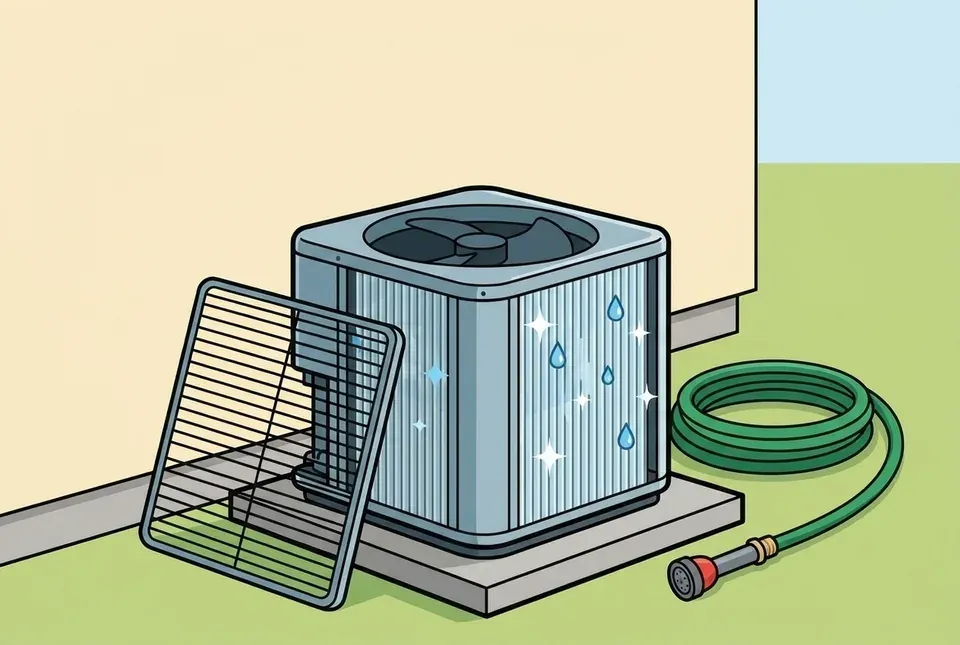
The outdoor unit breathes through its coil. When that coil packs with cottonwood, grass clippings, dust and pollen, the system cannot dump heat properly, head pressure climbs, and the whole machine works harder for less cooling.
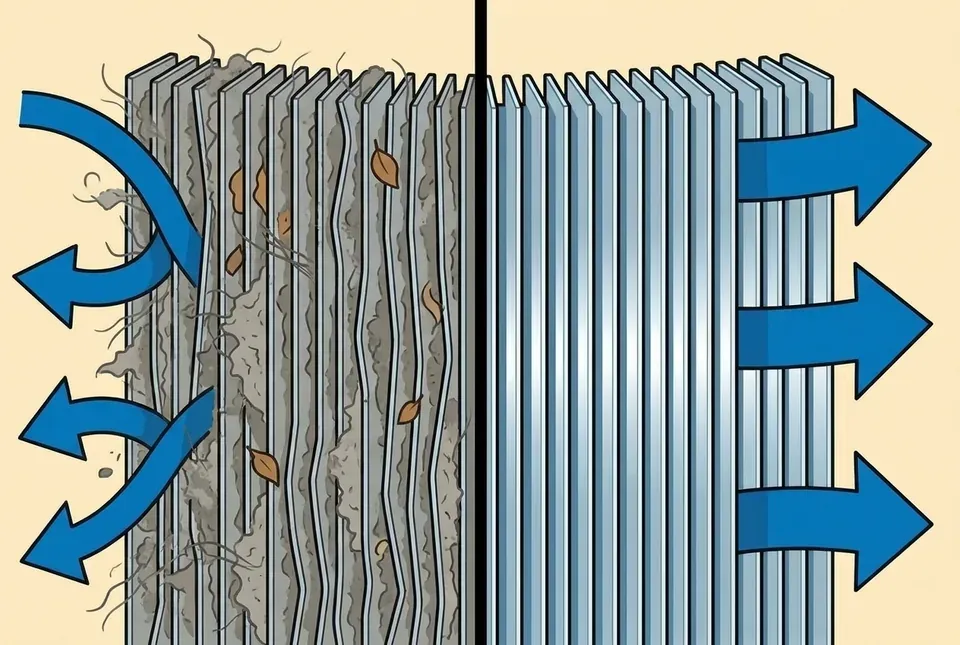
Kill the power first, and do it properly. Pull the outdoor disconnect, the small box mounted on the wall beside the condenser, or switch off the unit’s breaker if there is no disconnect. Turning the thermostat down is not the same thing and is not what we mean here. With the power off, the fan cannot start while your hands are near the cabinet, and hosing the coil cannot upset the refrigeration cycle mid run. Then use an ordinary garden hose, not a pressure washer, which will flatten the fins and do lasting damage. Aim downward and rinse through the coil rather than blasting across it.
You may have seen the top grille lifted out of a condenser to get at the coil from the inside. That is a technician’s step. It brings the fan motor and its wiring up out of the cabinet on a short harness, and a homeowner rinse does not need it.
Direction matters by brand. Most conventional coils are rinsed from the outside inward, angled down. Some designs, notably spine-fin coils, need rinsing from both directions to clear properly. If you are unsure which you have, rinsing gently from outside is the safe default.
Finally, give it room. Keep shrubs, weeds and stacked garden things at least a foot and a half back from the cabinet on all sides. A unit boxed in by a hedge is being slowly strangled.
What Does Skipping AC Service Cost You in Repair Bills?
We are not going to quote you numbers, partly because every system is different and partly because the real answer is not a number at all. It is which repair you end up having.
Skipped maintenance does not usually produce one dramatic failure. It produces a chain. A dirty coil restricts airflow, restricted airflow drops the coil below freezing, and the system ices over instead of cooling. That is a bad afternoon and a frozen AC unit that has to be thawed properly before anyone can even diagnose it. Run it long enough in that state and the compressor, the single most expensive component in the system, is the thing taking the strain.
A weakening capacitor is the same story. It degrades quietly and then fails without warning, usually on the hottest day, because that is when it is asked for the most. Caught during an inspection it is a small planned part. Caught in August it is an emergency call.
The other consequences are not about repair at all. A clogged condensate drain puts water into a ceiling. On the heating side, an uninspected heat exchanger is a carbon monoxide question, which is a different category of risk entirely. And airflow problems, dirty blower components among them, can cost you a meaningful share of your system’s efficiency, which ENERGY STAR puts as high as fifteen percent, paid quietly every month on your bill.
Missing documented service can also void a manufacturer’s warranty, which turns a covered part into an uncovered one.
How Do You Weigh an AC Maintenance Plan Against Paying Per Visit?
A plan is not automatically better value, and it is not automatically a trap. What decides it is the contract, so read it before you sign it.
Look for what the plan actually commits to performing. If the tasks are described as a visual inspection, you are buying a look rather than a service, and the meaningful work will be billed separately anyway. A plan whose task list matches the checklist earlier in this article is worth considering. One that does not is a subscription to a visit.
Then look at the terms around it. How long are you committed for, what happens if you cancel, and does the plan include the things people actually value, such as priority scheduling during a heat wave, when the difference between today and Thursday is the whole point.
One distinction trips people up regularly. A contractor’s labor warranty and the manufacturer’s parts warranty are separate things with separate terms, and a plan may affect one while doing nothing for the other. It is worth knowing which you are being offered, and we lay out how parts and labor coverage actually differ if that is unfamiliar.
Paying per visit is a perfectly reasonable choice for a newer system in good condition, as long as you actually book it. The most expensive maintenance strategy is the one where you intend to call every spring and do not.
If you would rather hand this to someone, our seasonal tune-ups cover the checklist above, and the technician will walk you through what they measured before they leave. That habit of showing our work is a large part of why families here have stayed with us for three generations.