Smart Thermostats vs. Traditional Thermostats: Which Is Right for Your Home?
We replace thermostats in Northern Virginia homes every week, and the same question comes up almost every time: is a smart thermostat actually worth it, or is a plain one fine? Honestly, it’s a great buy for some homes and a waste of money in others, and you can usually tell which camp you’re in before you spend a dime. Here’s the comparison we walk homeowners through.
Quick answer
If your system is compatible, you’ll be in the house a few more years, and someone in the household will actually use the app, a smart thermostat typically pays for itself within two to three heating and cooling seasons. A traditional thermostat is genuinely the better pick for simple single-stage systems, rentals, tight budgets, and households that just want to set a temperature and forget it. The deciding factor usually isn’t the feature list, it’s whether the thermostat matches your wiring and equipment.
How each type actually works
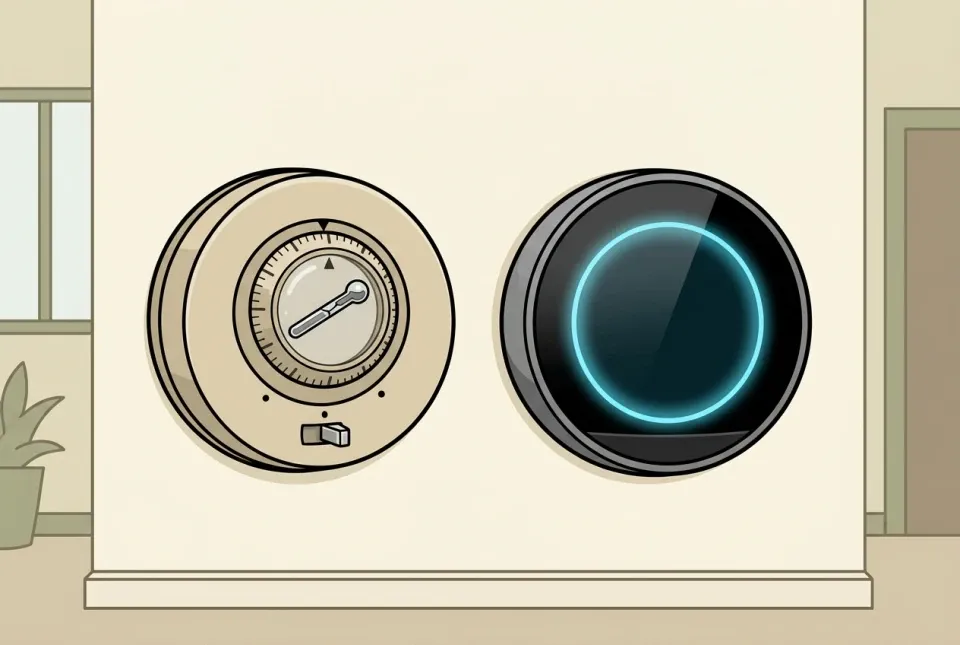
A traditional thermostat is a switch with a temperature sensor. You set 72, it turns the system on until the house hits 72, and it holds that number until you change it. Programmable versions add time slots, so the heat can drop to 65 overnight and come back up before the alarm goes off, though you have to program the slots yourself, and most people never do.
A smart thermostat does the same core job with three additions: it connects to Wi-Fi so you can control it from a phone, it collects data about your home and habits, and it makes decisions on its own. It knows the outdoor weather, notices when the house is empty, and adjusts run times on its own.
Neither type heats or cools better. A $30 thermostat and a $250 thermostat command the exact same equipment. What you’re paying for is how intelligently that equipment gets used.
Upfront cost vs. long-term savings
A basic traditional thermostat runs about $25 – $60, and a decent programmable model $40 – $100. Smart thermostats run roughly $80 – $250 for the hardware, plus installation if your wiring needs work.
On the savings side, the numbers are real but modest. Independent estimates put smart thermostat savings around 8% of heating and cooling costs, which for a typical Northern Virginia home works out to roughly $50 – $100 a year. That math usually means a smart thermostat pays for itself in two to three seasons, faster if your utility kicks in a rebate.
The catch: those savings come from setbacks, letting the temperature drift while you sleep or while the house is empty. If you already hold one temperature around the clock on purpose, there’s much less waste to recover and the payback stretches out.
What the extra money actually buys
Beyond raw savings, four features do the heavy lifting:
Learning schedules. The better models build your schedule by watching how you adjust them over the first week or two. This matters because it solves the real problem with programmable thermostats, which is that nobody programs them.
Remote control. Warming the house before you land at Dulles, or checking that the heat is on during a cold snap while you’re away. Once people have this, they don’t give it up.
Energy reports. Monthly usage summaries show when your system ran and how you compare to similar homes. They also flag problems early: run times creeping up month over month are often the first sign of a failing component or a refrigerant leak.
Utility rebates. Several Northern Virginia utilities offer rebates or bill credits for qualifying smart thermostats, and some pay ongoing credits for demand-response enrollment. Check current offers before you buy; a rebate can cover a third or more of the hardware cost.
If you’ve decided smart is the way to go and want to compare specific models, see our smart thermostat picks for how Nest, ecobee, and the sensor-equipped options stack up.
When a traditional thermostat is genuinely the better pick
We install plenty of traditional thermostats, on purpose, for homeowners it fits. It’s the right call when:
- The system is simple and the schedule is steady. A single-stage furnace and AC in a home where someone is around most of the day gives a smart thermostat very little to optimize.
- It’s a rental. Landlords generally shouldn’t put a $250 thermostat on the wall of a tenant-occupied unit, and tenants shouldn’t invest in hardware they’ll leave behind.
- Nobody wants another app. A smart thermostat that never gets connected to Wi-Fi is just an expensive programmable thermostat. For tech-averse households, a clear dial or simple buttons get used correctly far more often.
- The budget is the budget. If it’s a choice between a premium thermostat and this year’s maintenance visit, take the maintenance. The tune-up protects a five-figure system; the thermostat saves a few dollars a month.
Compatibility: the part that decides for most homes
This is where thermostat shopping goes wrong, and it’s the number one reason we get called to fix a self-installed unit.
The C-wire. Most smart thermostats need a common wire for constant power. Plenty of older Northern Virginia homes never had one pulled to the thermostat. The fix is running a new wire or using a manufacturer’s power adapter, but skipping it leads to dead screens and short-cycling.
Heat pumps with auxiliary heat. A heat pump needs a thermostat that handles the O/B reversing valve and manages backup heat correctly. Misconfigure that, and the thermostat quietly runs expensive electric strip heat all winter. Your house stays warm while your bill climbs, and nothing looks broken.
Multi-stage and dual-fuel systems. Two-stage equipment, variable-capacity systems, and heat pump plus gas furnace combinations all need a thermostat rated for them. Put a basic model on sophisticated equipment and you lose the efficiency you paid for when you bought the system.
If any of those describe your setup, answer the compatibility question before you buy anything: use the manufacturer’s online checker, or call us with a photo of your current wiring.
Frequently asked questions
Do smart thermostats really save money? Yes, but modestly: around 8% of heating and cooling costs for a typical home. The savings are largest for households that are away during the day and never bothered programming their old thermostat.
Can I install a smart thermostat myself? On a single-stage system with a C-wire already present, many homeowners do it successfully. For heat pumps, dual-fuel, multi-stage systems, or missing C-wires, have a pro handle it. Miswiring can damage equipment or silently waste energy for years.
What happens if the Wi-Fi goes out? The thermostat keeps working as a normal thermostat. You lose remote access and learning updates until the connection returns, but heating and cooling continue on the last schedule.
Is a programmable thermostat a good middle ground? Only if you’ll actually program it and keep the schedule current. Most people don’t, which is the exact problem smart thermostats were built to solve.
Ready to upgrade, or want a straight answer on what your system can support? Leonard Splaine installs and configures thermostats of every type across Northern Virginia. Call 703-494-2855 or request service online.