Furnace Burner Won't Stay Lit? Here's Why It Keeps Shutting Off
Quick answer
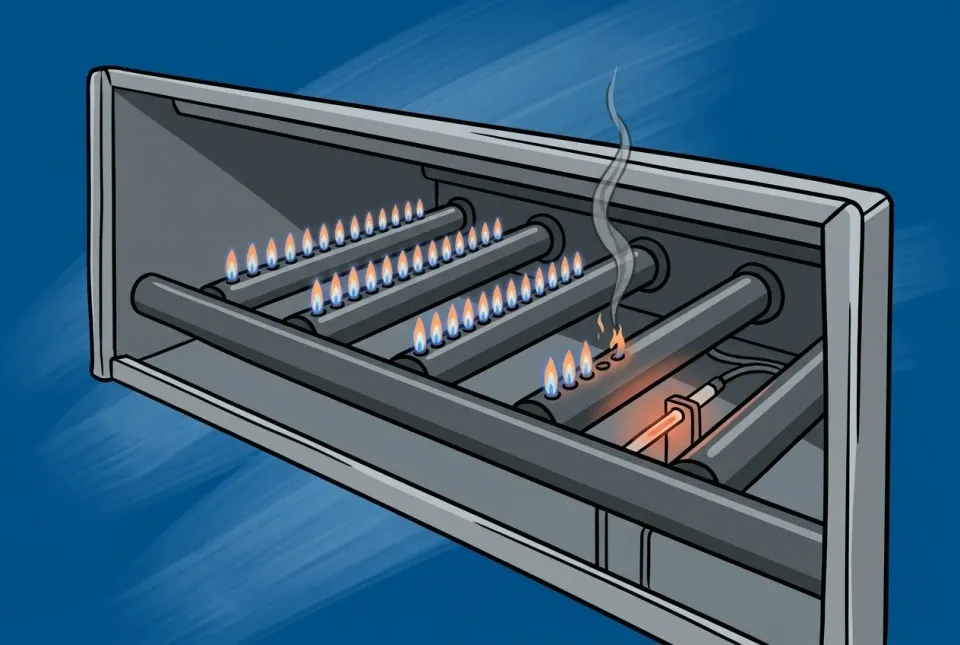
If your furnace lights, burns for a few seconds to a couple of minutes, then shuts off, the most common cause is a dirty flame sensor. Right behind it: a failing igniter or thermocouple, a tripping pressure switch, or a clogged air filter choking the system. This start-then-stop pattern is called short cycling on the flame, and it’s almost always a safety device doing its job, not a random glitch.
You can safely check a few things yourself. The actual repair belongs to a technician, because it involves gas and combustion.
Why a furnace shuts itself off on purpose
Modern furnaces are built to fail safe. Every time yours fires up, a small chain of events has to go right, and a set of sensors is watching for anything wrong. If any one of them doesn’t like what it sees, it kills the gas rather than risk a problem. So a furnace that won’t stay on is usually a healthy safety system reacting to a dirty or worn part.
Here’s the normal sequence on a typical modern furnace:
- Your thermostat calls for heat.
- The draft inducer fan starts and clears the combustion chamber.
- The pressure switch confirms that fan is actually moving air.
- The igniter glows or sparks, and the gas valve opens.
- The burners light.
- The flame sensor confirms a real flame within a couple of seconds.
If step 6 fails, the furnace assumes gas is flowing with no flame, and it shuts down instantly. That’s the shutoff you’re seeing.
The most common cause: a dirty flame sensor
The flame sensor is a thin metal rod that sits in the burner flame. It doesn’t light anything, it just confirms the flame is really there by sensing a tiny electrical current the flame carries. Over a season or two, it picks up a film of soot and oxidation. Once that coating gets thick enough, the sensor can’t “see” the flame anymore, so the furnace does exactly what it’s designed to do and shuts off the gas.
The classic symptom: the furnace lights cleanly, runs 5 to 90 seconds, then quits, and tries again a few minutes later. That repeating cycle is the giveaway.
Typical cost: $150 – $300 for a technician to clean or replace the sensor. A flame sensor is a cheap part, and cleaning one is a routine part of a furnace tune-up, which is why a fall maintenance visit heads this problem off before the first cold snap.
Other reasons a burner won’t stay lit
A failing igniter
Most furnaces today use a hot surface igniter instead of a standing pilot light. These wear out, and a cracked or weak igniter may glow but not get hot enough to light the burners reliably, or light them late. If yours clicks and tries repeatedly without a steady flame, the igniter is a prime suspect. Typical cost: $200 – $450 installed.
A bad thermocouple (on older pilot-light furnaces)
If you have an older furnace with a standing pilot light, the equivalent part is the thermocouple, a probe that senses the pilot flame and keeps the gas valve open. When it weakens, it misreads the flame as out and shuts the gas down. Typical cost: $150 – $350.
A tripping pressure switch
The pressure switch confirms the draft inducer is venting exhaust safely. It trips and shuts the furnace down when it senses poor airflow, which is often caused by a blocked flue or intake pipe, a clogged condensate line on high-efficiency units, or a cracked hose. Because this one protects you from carbon monoxide backing up, it’s not something to bypass. Typical cost: $150 – $400, more if the root cause is a venting problem.
A clogged air filter
A filter packed with dust starves the furnace of airflow, and the resulting heat buildup trips the high-limit switch, shutting the burners off to prevent overheating. It’s the cheapest possible cause and the easiest to rule out.
What you can safely check yourself
Before you call anyone, take two minutes on these:
- Change the air filter. If it’s gray and you can’t see light through it, replace it. This alone fixes a surprising number of short-cycling furnaces.
- Check the thermostat. Make sure it’s set to Heat, the batteries are fresh, and no one changed the schedule.
- Confirm the furnace door is fully seated. A safety switch cuts power if the front panel isn’t closed all the way.
- Look outside (high-efficiency furnaces). Make sure snow, ice, or leaves aren’t blocking the white PVC intake and exhaust pipes on the exterior wall.
- Reset the furnace once by cutting power at the switch for 30 seconds.
When to stop and call a pro
Stop troubleshooting and call if you notice a smell of gas (leave the house first and call from outside), soot around the burners, a yellow or lazy flame instead of crisp blue, repeated lockouts, or the furnace tripping its own breaker. Anything involving the gas valve, burners, heat exchanger, or venting is a licensed technician’s job, both for safety and to keep your manufacturer warranty intact.
A furnace that keeps quitting on the coldest night of the year is miserable, but the fix is usually small and fast once someone can watch the ignition sequence and see exactly where it breaks down.
Frequently asked questions
Is a short-cycling furnace dangerous? The shutoff itself is a safety feature working correctly. The risk is in ignoring it or bypassing a safety switch. Running a furnace with a real venting or gas fault is what becomes dangerous, so get it diagnosed rather than defeated.
Can I clean the flame sensor myself? It’s physically simple, but it means opening a gas appliance and removing a component near the burners. We recommend leaving it to a technician, who will also check why it fouled in the first place and confirm the rest of the ignition system is healthy.
How do I prevent this next winter? A fall furnace tune-up cleans the flame sensor, checks the igniter and pressure switch, and swaps the filter, which is exactly the short list of parts behind most no-stay-lit calls.
Furnace lighting and quitting on you? Leonard Splaine has kept Northern Virginia homes warm for three generations, with honest diagnostics and upfront pricing across Fairfax, Prince William, Arlington, Alexandria, and Stafford. Call 703-494-2855 or book a heating repair online.