ECM vs. PSC Blower Motors: What HVAC Motor Types Mean for Your Bills
Quick answer
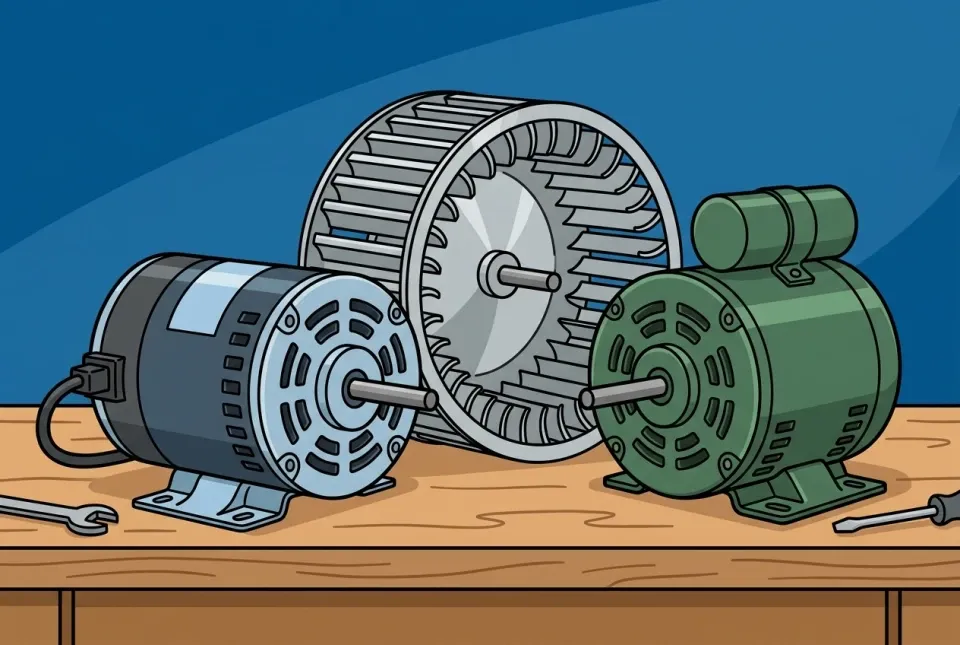
Your furnace or air handler runs on one of two blower motor types: an older PSC motor (permanent split capacitor) or a modern ECM motor (electronically commutated motor, also called variable-speed). The short version: a PSC motor runs at one flat-out speed and is cheap to replace but costs more to run. An ECM motor ramps up and down to match demand, uses far less electricity, and runs quieter, but costs more to buy. Knowing which you have helps you make a smart repair-versus-replace call when the motor eventually fails.
What the blower motor actually does
The blower motor is the workhorse of your heating and cooling system. It’s the fan that pushes conditioned air through your ducts and out your vents, and it runs every time the system calls for heating or cooling. Because it moves so much air for so many hours, the blower is one of the biggest electricity users in the whole system, which is exactly why the type of motor matters to your bills.
PSC motors: simple, cheap, single-speed
A PSC motor is the traditional design that’s been in furnaces and air handlers for decades. It’s a straightforward AC motor with a start capacitor, and its defining trait is simple: it runs at one fixed speed. When your system turns on, the blower jumps straight to 100 percent; when the cycle ends, it stops. There’s no in-between.
The upsides: PSC motors are reliable, mechanically simple, and inexpensive to replace, usually a few hundred dollars for the part and labor.
The downside: running full-blast every cycle wastes energy, and the all-or-nothing airflow tends to feel drafty and produce bigger temperature swings between rooms. On top of that, older PSC-driven systems generally sit at lower efficiency ratings overall.
If you have one: it’s probably in a furnace or air handler that’s 12 or more years old.
ECM motors: variable-speed and efficient
An ECM motor is the modern standard. It’s a smarter design with a built-in control board and a permanent-magnet, DC-style motor that runs off your home’s AC power. That control board lets it do the one thing a PSC motor can’t: run at whatever speed the moment actually calls for.
Instead of slamming on at full power, an ECM blower starts gently and adjusts continuously, running low and long most of the time and only ramping up when the house needs it. That’s where the benefits come from:
- Lower energy use. An ECM blower can use meaningfully less electricity than a PSC unit, and because it runs at low speed for long stretches, those savings add up month after month.
- Better comfort. Long, low-speed runs even out the temperature between rooms and cut down on the cold-blast-then-nothing feeling.
- Quieter operation. A motor that spends most of its life at 40 percent is far quieter than one that’s always at 100.
- Better humidity control. Slower airflow pulls more moisture out of the air in a Northern Virginia summer, so the house feels cooler at the same thermostat setting.
The trade-off: an ECM motor and its control board cost more to buy and more to replace than a PSC motor. When one fails out of warranty, the repair is a bigger number, which feeds directly into the decision below.
ECM vs. PSC at a glance
| PSC motor | ECM motor | |
|---|---|---|
| Speed | Single, fixed | Variable |
| Energy use | Higher | Lower |
| Comfort / even temps | Fair | Better |
| Noise | Louder | Quieter |
| Humidity control | Basic | Better |
| Cost to replace | Lower | Higher |
| Typically found in | Older systems (12+ yrs) | Newer, higher-efficiency systems |
Why this matters when a motor fails
Here’s the practical payoff. When a blower motor dies, the fix depends on which type you have and how old the system is:
- A failed PSC motor in an aging system: the part is cheap, so a straight replacement often makes sense to buy a few more years, especially if the rest of the system is healthy.
- A failed ECM motor still under warranty: you generally pay labor while the manufacturer covers the part, so repair is usually the clear choice.
- A failed ECM motor out of warranty on an old system: the motor plus control board is a significant cost, and if the system is 12 to 15 years old, that money is often better put toward a new, higher-efficiency system that will cut your bills instead of just restoring them.
A good technician will tell you which motor you have, whether it’s under warranty, and give you the honest math both ways rather than defaulting to the bigger ticket.
Frequently asked questions
How do I know which motor I have? The quickest tell is age and behavior: if your system is more than a dozen years old and the airflow is either full-force or off with nothing in between, it’s almost certainly a PSC motor. A technician can confirm it in seconds by checking the blower and its wiring.
Is it worth upgrading from PSC to ECM on its own? Usually not as a standalone swap, the motors aren’t always a direct drop-in, and the payback is slow. The better time to capture ECM efficiency is when you’re replacing the furnace or air handler anyway.
Do ECM motors last as long as PSC motors? Yes, often longer. The added complexity is the control board, but a quality ECM motor running at gentle speeds tends to have an easy life. Keeping the filter clean protects either type.
Not sure what’s humming away in your basement, or facing a blower repair-or-replace decision? Leonard Splaine has served Northern Virginia families for three generations with straight answers and upfront pricing. Call 703-494-2855 or schedule a system checkup.