How Much Does an AC and Furnace Combo Cost to Replace?
Quick answer
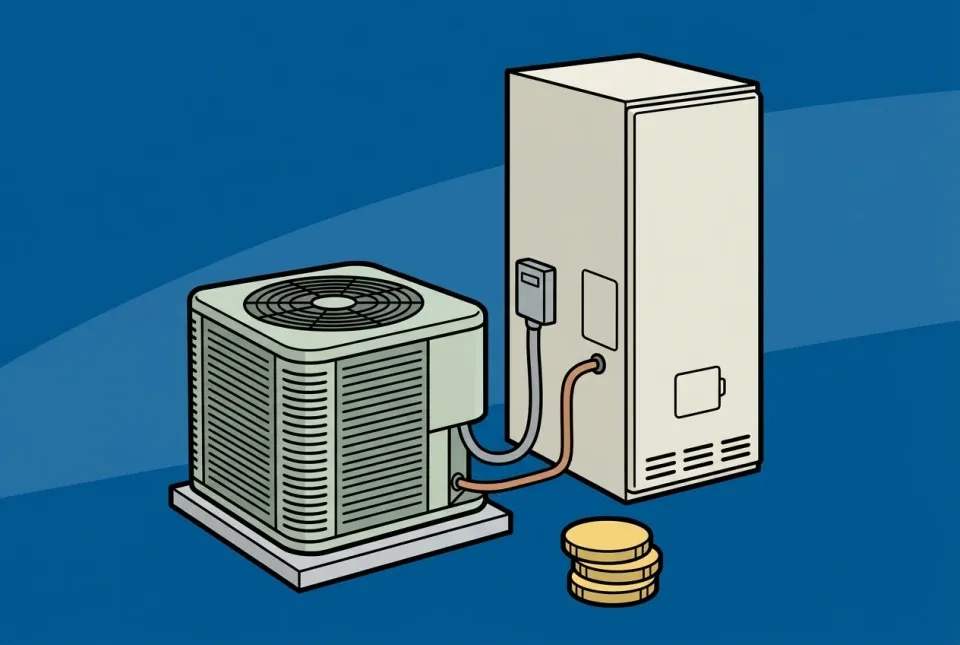
For most Northern Virginia homes, a matched air conditioner and furnace combo runs about $6,000 to $18,000 installed, depending on the efficiency tier you choose, the size of your home, and the condition of your ductwork. Basic single-stage systems sit at the low end; premium variable-capacity systems land at the top. Replacing both units together, when they’re close in age, is almost always cheaper than doing two separate installs a couple of years apart.
Why replace both at once
Your furnace and AC share the same ductwork, the same blower, and often the same indoor cabinet. When one is near the end of its life, the other usually isn’t far behind, most systems last about 15 years here. Installing a matched system, one where the furnace and AC are engineered to work together, gets you better efficiency, cleaner humidity control, and a single warranty clock. You also pay for labor and permitting once instead of twice.
Combo cost by tier
Equipment is grouped into three tiers: basic, better, and best. Here’s what each typically costs installed in our area.
| Tier | Furnace | AC | Typical installed cost |
|---|---|---|---|
| Basic | 80–92% AFUE, single-stage | 13–15 SEER2, single-stage | $6,000 – $9,000 |
| Better | 94–96% AFUE, single or two-stage | 16–18 SEER2, single or two-stage | $9,000 – $13,000 |
| Best | 96–98% AFUE, variable-capacity | 18–20+ SEER2, variable-capacity | $12,000 – $18,000 |
Basic systems cost the least upfront but run at maximum output whenever they’re on, so they cost more to operate and offer few comfort features.
Better two-stage systems spend most of their time on a quieter, more efficient low setting and only ramp to full power when the weather demands it. For a lot of Northern Virginia homes, this tier is the value sweet spot.
Best variable-capacity systems modulate in small increments to hold rock-steady temperatures, run the quietest, and manage summer humidity best. They cost the most but earn some of it back on your energy bills over time.
What moves the price
Four factors do most of the work:
- Efficiency rating. Higher AFUE and SEER2 numbers cost more upfront and save more monthly.
- System size (capacity). Central ACs range from 1.5 to 5 tons; furnaces from roughly 45,000 to 120,000 BTU. Bigger capacity costs more, but oversizing is a real problem, not a safety margin.
- Installation difficulty. A tight attic, a cramped crawlspace, or major layout changes add labor.
- Ductwork condition. Leaky, undersized, or incomplete ducts can add $500 to $3,000, and skipping that work means your new system never performs to spec.
Getting the size right
An oversized system is one of the most common (and expensive) mistakes in our area. Too much capacity makes the system short-cycle, blasting on and off, which wears out parts faster, wastes energy, and leaves your home clammy because it never runs long enough to pull humidity out of the air.
A rough starting point is 25 to 45 BTU per square foot, so a 2,000-square-foot home might land somewhere around 60,000 to 90,000 BTU. But that’s only a starting point. Your home’s insulation, window count and orientation, ceiling height, and layout all change the real answer. A proper Manual J load calculation is the only way to size a system correctly, and any quote that arrives without one is a guess.
Other combo options to consider
A gas furnace and AC isn’t your only choice:
- Heat pump and air handler. One all-electric system that both heats and cools. Great for our mild winters, and increasingly popular. Typical installed cost runs $8,000 to $16,000.
- Dual-fuel (heat pump + gas furnace). The heat pump handles efficient heating most of the season and the furnace kicks in on the coldest nights. You get low heat-pump bills most of the year and furnace muscle when it matters. This is the setup we find ourselves recommending most for homes with gas service.
How to get a fair price
- Never trade installation quality for a lower bid. A cheap install on great equipment still fails early.
- Get at least three quotes and let each contractor know they’re competing.
- Ask what’s included: permits, disposal of the old equipment, line set and pad replacement, and any electrical work. A number that leaves those out isn’t really a quote.
- Check for current rebates and financing. Manufacturer rebates and 0% or low-monthly promotional financing come and go seasonally and can meaningfully change your out-of-pocket cost.
Frequently asked questions
Is it cheaper to replace the AC and furnace together? Usually, yes. You pay for labor, permitting, and a service visit once instead of twice, and a matched system runs more efficiently than two mismatched units.
How long does a combo install take? Most are one-day jobs. Add ductwork or electrical changes and it can stretch to two.
How long will a new combo system last? Around 15 years for a properly sized, well-maintained system. Annual maintenance is what gets you to the high end and keeps the manufacturer warranty valid.
Want a real number instead of a range? Leonard Splaine gives free, itemized estimates on matched heating and cooling systems across Northern Virginia, with a load calculation, not a guess. Call 703-494-2855 or request an estimate online.